Why Your Paslode Nail Gun Stops Working (And What It Really Costs You)
I'm the office administrator for a 40-person construction company. I manage all tool and equipment ordering—roughly $60,000 a year across 9 vendors. I report to operations on lead times and to finance on budget. If a Paslode nail gun goes down on a job, it lands on my desk.
So when two framing crews called in the same week saying their Paslode nail guns wouldn't fire, my first thought was the same as anyone's: batteries. I searched 'batteries for paslode nail guns' before I checked the tools themselves.
That was my first mistake.
The Surface Problem: It Won't Fire
The typical story goes like this: a crew lead grabs a nail gun, pulls the trigger, and nothing. The fuel cell looks full. The battery indicator is blinking. The gun is less than a year old. The obvious answer is 'buy a new battery.' I've placed that emergency order more than once.
The truth is messier. A Paslode cordless nail gun depends on three things: fuel, battery, and mechanical health. If any one fails, the gun behaves in exactly the same way—silence. That's why 'batteries for paslode nail guns' is such a common search. A genuine replacement battery runs roughly $40–$60 (based on major retailer listings, February 2025; verify current pricing), but a new battery won't fix a dirty firing chamber.
Deeper Cause #1: The Battery Is a Partner, Not Just an Accessory
Paslode's gas-powered nailers use the battery for three jobs: igniting the fuel, fanning the combustion, and running the chamber cycle. An old battery can still show enough voltage to light the display but not deliver the current the ignition needs. I learned this the hard way.
In 2022, I bought 12 batteries from a discount supplier. The price was 30% below our normal vendor. Six weeks later, one of our nailers started failing intermittently. A repair tech found a swollen battery cell. The battery had been drawing too much current under load, and the extra heat probably accelerated wear on the tool's internal contacts.
I'm not saying every compatible battery is junk. But when you search for 'batteries for paslode nail guns,' you're not just buying a portable power pack—you're buying the ignition system's partner. The manual calls for a specific voltage and current profile. 'Compatible' isn't necessarily identical.
It took me two years and about 30 repair orders to understand that cheap batteries are expensive, just in a different currency.
Deeper Cause #2: Dirt Is the Silent Killer
Then there's the part nobody wants to buy: paslode nail gun cleaner. It looks like a maintenance upsell. For my first year, I didn't stock it. The crew wiped the guns down with a dry rag, and I thought that was enough.
It wasn't. A Paslode nailer burns fuel and drives fasteners at high speed. Combustion residue collects in the firing chamber, on the piston, and around the nose. Over time, that residue hardens into a kind of varnish. The gun slows down, fails to fully cycle, and eventually jams. The symptoms are almost identical to a dying battery.
According to Paslode's product guidelines, regular cleaning with the branded cleaner is part of normal maintenance after heavy use (Source: Paslode product documentation, paslode.com, accessed 2025). A can of paslode nail gun cleaner runs about $12–$18 (based on major online retailer listings, March 2025; verify current pricing). I ignored that for 11 months. In 2023, I compared our repair tickets side by side—same number of nailers, same jobs, different cleaning habits. The result was painfully clear: $120 of cleaner and a few hours of labor had prevented more than $1,900 in repairs.
That's a contrast every time I see 'paslode nail gun cleaner' on a purchase order.
Deeper Cause #3: The 'Simple' Question Problem
I think the biggest hidden cost isn't parts. It's diagnoses.
When our maintenance guy asks 'how do you measure an oil filter wrench?' before ordering one, that's a good question. It takes thirty seconds to answer and saves a wrong purchase. The same logic should apply to tools that suddenly stop working. Instead, we skip the diagnosis and order parts: a battery, a fuel cell, a rebuild kit.
We've also had non-Paslode equipment fail for boring reasons. 'pressure washer not turning on' was one of our top maintenance searches last summer. The first fix wasn't a new pump—it was resetting the GFCI outlet. The second was a tripped breaker. Only after those did we look at the switch. Most people would've replaced the engine.
Why does this matter? Because the process is the same for a Paslode nail gun. Check the simple things first. In order: battery state, fuel cell, and cleanliness. If those are fine, then and only then should you order a replacement part.
What This Costs You
Every hour a nailer sits idle on a framing job is not just an hour of repair time. The crew still gets paid. The truck still costs money. The schedule slips. In the construction industry, expensive tools often pay for themselves in a day. A single breakdown can wipe out the margin on a small task.
For my company, a two-man framing crew with an idle nailer costs roughly $180/hour in loaded labor and overhead. If the gun stays down for a full day, that's over $1,400. A $12 can of cleaner starts to look like the best insurance policy we've ever bought.
Granted, not every breakdown is preventable. Fuel cells leak occasionally. Batteries do age. But most of the Paslode-related issues I've seen in the past five years were avoidable.
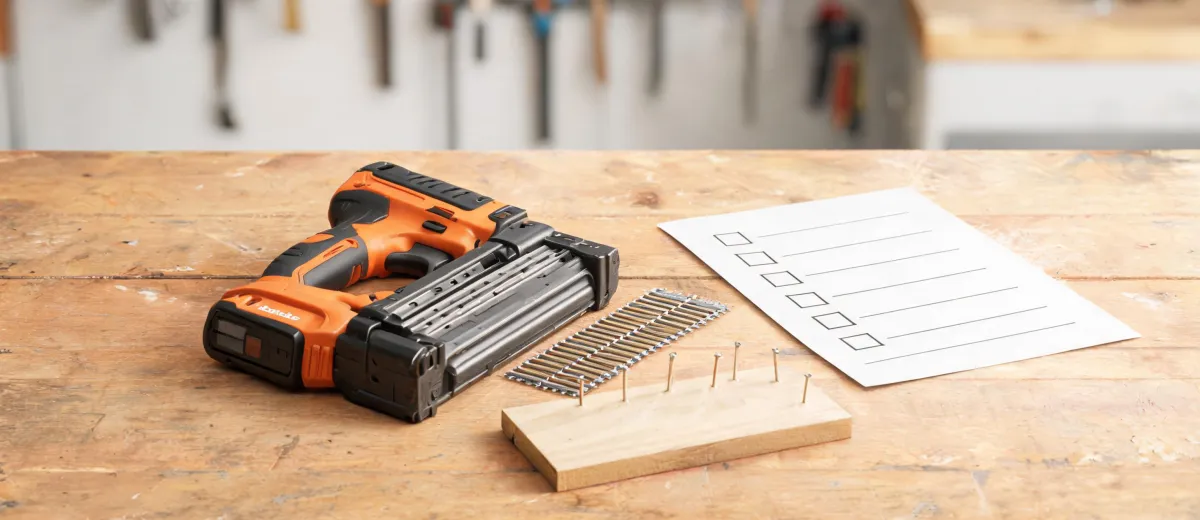
The Fix: A Simple Checklist Before You Search
Here's what I now do before ordering any Paslode part:
- Run a full cycle with a known-good battery and a fresh fuel cell. This isolates the gun's mechanical action from the electronics.
- Clean the tool with paslode nail gun cleaner, following the nozzle and dwell time on the can. Most residue needs thirty seconds to dissolve.
- Check the battery contact points and the fuel cell chute. Grit in either one mimics a dead battery.
- If the gun still fails, record the exact symptom—no spark, weak cycle, no cycle—and take a video. A repair tech can diagnose faster with video than with a verbal description.
The same discipline applies to other tools. When we bought a v20 1/2 in. cordless drill kit for the trim crew, I didn't just order the kit—I checked the charger compatibility and planned a rotation for battery stations. It felt like overkill at the time. It meant fewer dead batteries on site throughout 2024.
The point isn't to avoid buying batteries. It's to avoid buying them twice. 'batteries for paslode nail guns' is a legitimate search. It should be the result of a diagnosis, not the start of one.
Final Thought
The most valuable thing I've learned as an office buyer is that tools fail in patterns. A pressure washer not turning on is usually electrical, not mechanical. An oil filter wrench question is usually a measurement problem, not a tool problem. And a Paslode nail gun that stops firing is usually dirty, tired, or forgotten—not dead.
Check for the boring answer first. You'll save more money in a morning than most vendors will quote you all year.

Maren Jorgensen
Maren Jorgensen is an independent hand tool and torque applications analyst covering wrenches, pliers, screwdrivers, hammers, sockets, ratchets, hex keys, and tool sets. She applies ISO 6789-1 torque-tool conformance principles while examining jaw capacity, leverage, fastener engagement, torque range, accuracy, handle geometry, and material hardness. Her practical guides help tradespeople and procurement teams select suitable tools, plan controlled tightening, and compare durability without relying on brand reputation alone.