4 Years of Inspecting Nail Guns: Is Paslode the Best Nail Gun? Here's What I Found
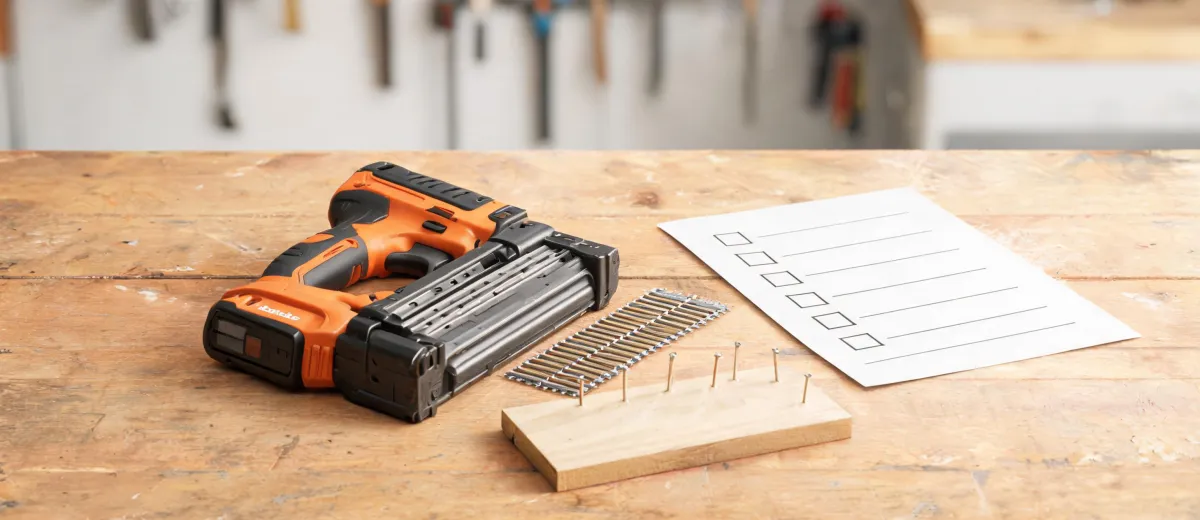
A Pallet I Didn't Trust from the Start
The shipment of 200 Paslode cordless framing guns showed up on a Tuesday in March 2024. I remember looking at the pallet, shrink-wrapped and stacked taller than me, and thinking: this is going to be a long week.
We'd carried the Paslode line for about six months at that point, and I still wasn't sold. Everything I'd read about cordless nailers said the same thing—they're heavy, they jam more than pneumatics, and they can't keep pace on a serious production site. I grew up around air tools. A compressor, a hose, a gun that never stops. Cordless felt like a downgrade waiting to happen.
I work as a quality compliance manager on the distribution side of the tool industry. If it ships to a contractor, I've signed off on it. That's 200+ unique products a year. The range is wide: master mechanics tool sets, specialty fasteners like Duraspin cement board screws, even a plumbing request that had me research what a wafer-type butterfly valve is for a project bid (spoiler: it's a compact quarter-turn valve; the paperwork was as dull as it sounds).
The principle I've settled on after four years: verify the spec, don't assume.
What an Inspection Actually Looks Like
Our protocol isn't complicated, but it is relentless. Every unit goes through a cycle test—minimum 60 drives per tool. On a 200-unit batch, that's 12,000 nail strikes, all logged.
The checklist:
- Drive depth consistency (flush to 1/16 inch below the work surface)
- Jam rate per 100 nails
- Trigger response, including full-sequence safety lockout
- Fuel cell seating and battery contact reliability
- Power output at the end of a 30-second continuous burst
The numbers go into a spreadsheet. The spreadsheet becomes a report. The report determines whether a batch clears or gets rejected. When I implemented our verification protocol in 2022, the rejection rate jumped—contractors noticed, vendors noticed, and the quality bar moved up. That was the point.
A quick example to show how seriously we take this: in Q1 2024, we received a batch of 5,000 fasteners where the coating thickness was visibly off—0.6 mil against a 1.0 mil spec. Normal tolerance is 0.2 mil. The vendor claimed it was "within industry standard." We rejected the batch, and they redid it at their own cost. Now every fastener contract includes specific coating requirements.
So when the Paslode pallet arrived, I ran the same process without expecting much. The first units performed fine. Then unit 17. Then unit 46. By the time I hit unit 89, I'd called a colleague over to watch the cycle test.
The surprise wasn't that the Paslode guns worked. It was that they worked consistently. Jam rate across the batch landed just above 1%. Drive depth held within tolerance through every single test. That's the same range as the best pneumatic framing nailers we've reviewed—and this is a cordless gas-powered unit, not a tool tethered to a compressor.
A lesson learned the hard way: I'd carried suspicion about this technology for years. The data didn't agree with me.
The Field Test That Changed My Perspective
Bench tests tell you if a tool is built right. Field tests tell you if it works in the real world.
We sent a batch to a framing crew working on a 12,000-square-foot residential build in the summer of 2024. The crew lead had been framing for 15 years, most of it with pneumatics. When I visited on day 12, he said, "The compressor's still in my truck. Haven't touched it all week."
He wasn't trying to sell me on anything. He was just stating a fact. That's what made it persuasive.
Everything I'd read said cordless nailers couldn't hold up to production framing. In practice, for that crew and that job site, the Paslode cordless framing gun got the work done without hoses, without a compressor, without the setup and tear-down time that goes with both. The crew wasn't faster on individual nails. They were faster because they never had to stop and handle equipment.
I'm not 100% sure it would outperform a top-tier pneumatic on a massive industrial site day after day. But for residential and light commercial projects—which is where most framing crews actually earn their living—the advantage isn't shots per minute. It's time saved moving equipment around.
That crew finished two days ahead of schedule. I don't give the nail gun all the credit. But I do give it more credit than I would have a year ago.
Is Paslode the Best Nail Gun? Not a Simple Answer
People ask me this often, usually in a forum thread comparing specs. My honest answer: it depends on the workflow.
If you're building off-grid or framing a house where power isn't finalized, the Paslode is probably the best cordless framing gun you can buy. If you're working off a large compressor that's already on site, a pneumatic is still a workhorse. They're different tools for different conditions, and anyone who tells you one is objectively superior is probably selling something.
But let me flip the question around a little.
People think premium tools cost more because of brand recognition. I believe the causation runs the other direction. Paslode can charge what it does because the tool removes real bottlenecks on a job site. No compressor to transport. No hoses to untangle. No waiting for air pressure to recover after a long burst. If a crew saves 45 minutes of setup per day, that's roughly three to four hours of recovered labor per week. Over a month, that more than covers the cost of the fuel cells. The brand isn't really the product. The time is the product.
That's the part spec sheets don't capture, and it's the part I care about most.
The Efficiency Angle Nobody Talks About
Here's the thing: when you remove the airline from a job site, you remove a whole category of problems. No hoses to trip over. No compressors to service. No moisture frozen in the line on a cold morning—always a joy to diagnose at 7 a.m. No generator fuel to haul to the site.
We spend a lot of time in this industry talking about digital efficiency: software, scheduling, automated quoting. But analog efficiency moves the schedule. And moving the schedule is what actually puts money in a contractor's pocket.
I have mixed feelings about recommending cordless to every single contractor. On one hand, I've seen the gains with my own eyes. On the other, fuel cells are a recurring cost, and batteries do degrade over time. A pneumatic kit that's looked after will probably outlast all of us. That's a fact I respect.
So I'm not telling anyone to throw out their compressor. I'm saying the industry has been loading toward cordless for years, and Paslode is one of the reasons that trend picked up speed. The tool earned its place in the conversation.
What Four Years of Inspections Taught Me
If I've learned anything from reviewing 200+ products a year, it's that the best tool isn't the one with the flashiest spec sheet. It's the one that shows up, within tolerance, 200 units in a row.
Consistency beats peak performance. Specs are a starting point, not a verdict.
Would I buy a Paslode with my own money? I already recommended one to my brother for his deck project. The fuel cell cost still feels a little odd compared to free compressed air. But for a solo guy hauling tools between three sites a week, the convenience and time savings are real. I'd call that a pass.
Not ideal for every scenario. But honestly—what tool is?

Maren Jorgensen
Maren Jorgensen is an independent hand tool and torque applications analyst covering wrenches, pliers, screwdrivers, hammers, sockets, ratchets, hex keys, and tool sets. She applies ISO 6789-1 torque-tool conformance principles while examining jaw capacity, leverage, fastener engagement, torque range, accuracy, handle geometry, and material hardness. Her practical guides help tradespeople and procurement teams select suitable tools, plan controlled tightening, and compare durability without relying on brand reputation alone.