The $4,200 Quote That Looked Cheap—Until I Ran the Real Numbers
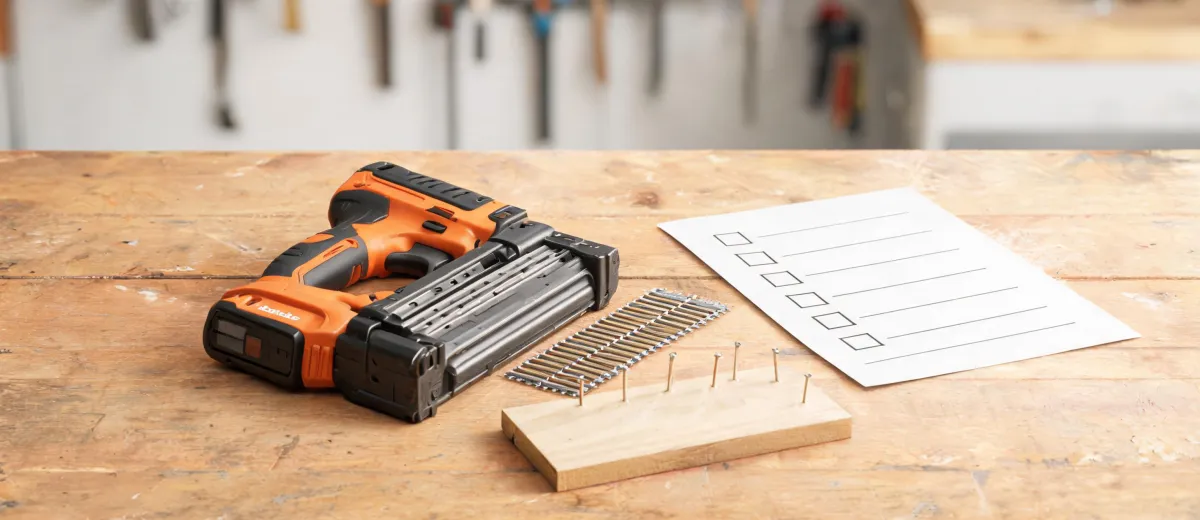
June 2023. We had three framing crews running at once, a subdivision deadline in eleven weeks, and a tool budget that was already $6,000 over where I wanted it to be.
I manage procurement for a 47-person construction company. I've been tracking our tool and consumable spend for about five years now—every invoice, every repair receipt, every fuel cell order goes into a spreadsheet. When you're buying Paslode nail gun 2nd fix units and cordless framing nailers across multiple crews, the numbers add up faster than you'd think.
That June, I got a quote that looked too good to pass up. A supplier offered us a bulk deal on off-brand cordless framing nailers—roughly 22% cheaper per unit than the Paslode 30-degree framing nailers we'd been running. Five units. The math on paper said we'd save about $4,200 across the order.
Why the Cheap Option Won the First Round
I'll be honest with you—I pushed for it. My gut said stick with Paslode, but the spreadsheet said the alternative saved us enough to cover two months of fuel cells. When you're staring at a tight budget, that's a hard argument to ignore.
So we bought five of them. Here's what the quote didn't tell us.
Week two: One unit jammed on a Paslode fasteners stack—the kind with the paper tape collation. The off-brand gun didn't feed reliably. We lost about 40 minutes on a Thursday morning.
Week four: A second unit stopped driving nails to depth. Inconsistent power, especially on engineered lumber. My lead framer, Ray—22 years in the trade—told me he didn't trust it on anything structural. That's a red flag I should've caught earlier.
Week six: Two units were in the shop. The turnaround was eleven days because the manufacturer didn't have a local service network. Meanwhile, the third unit was eating batteries faster than our Paslode guns ever did.
By week eight, we'd spent $1,850 on repairs, lost roughly 60 crew-hours to downtime, and rented two Paslode nail guns as backups at $95/day for six days. The "$4,200 savings" was already gone.
The Lesson: Cheap Isn't the Same as Low-Cost
People think the cheapest tool saves money. Actually, the tool that stays running saves money. The causation runs the other way.
That's the part most procurement folks—myself included, apparently—can talk ourselves out of when the quote looks clean. We treat unit price as the number that matters. But when you're running crews on a schedule, the real cost shows up in downtime, repair turnaround, and whether your guys actually trust the tool in their hands.
I ran the TCO after that project closed out. Here's what it actually looked like:
- Off-brand units (5): $6,150
- Repairs and parts: $1,850
- Rental backups: $570
- Lost crew time (60 hrs @ avg $48/hr loaded): $2,880
- Real total: $11,450
For comparison, five Paslode framing nailers at that year's pricing would've run about $7,900, with service through our local dealer and a documented reliability record across our existing fleet. We'd been running Paslode for six years before that experiment. We went back after it.
What I Changed
I built a TCO calculator into our procurement spreadsheet. It's not fancy—just base cost, projected consumables over 24 months (fuel cells, batteries, fasteners), historical repair rate per unit type from our own records, and a downtime estimate. Three columns and a formula.
The rule now: any tool quote over $2,000 goes through the calculator before I sign off. If the TCO story doesn't hold up, price doesn't matter.
One more thing I stopped doing—I don't compare tool prices in isolation anymore. When I look at something like an air compressor 1 gallon unit for trim work versus the cordless alternative, I'm weighing it against crew mobility, setup time, and whether we need a compressor on site at all. Same logic applies when someone asks how many amps does a welding machine use—the amp draw is only part of the story. Circuit capacity, duty cycle, and whether you're paying an electrician to upgrade a panel matters more than the spec sheet number.
Cheapest quote wins maybe 30% of the time now. The other 70%, the numbers tell a different story.
What I'd Tell Another Procurement Manager
Don't trust your gut alone—mine was right about the off-brand guns, but I overrode it because the spreadsheet said I should. That was a mistake.
But don't trust the spreadsheet alone either. Build the right spreadsheet. One that accounts for what happens after the invoice clears. Downtime has a dollar figure. Frustrated crews have a dollar figure. Service delays have a dollar figure.
If you're running Paslode already, you probably know what the reload rate feels like on a 30-degree framing gun versus a competitor's. That's not marketing—that's the difference between a crew that hits its daily target and one that doesn't.
The cheapest tool is the one you buy once and don't think about again. Everything else is just a deferred cost.

Maren Jorgensen
Maren Jorgensen is an independent hand tool and torque applications analyst covering wrenches, pliers, screwdrivers, hammers, sockets, ratchets, hex keys, and tool sets. She applies ISO 6789-1 torque-tool conformance principles while examining jaw capacity, leverage, fastener engagement, torque range, accuracy, handle geometry, and material hardness. Her practical guides help tradespeople and procurement teams select suitable tools, plan controlled tightening, and compare durability without relying on brand reputation alone.