The Cheapest Paslode Nail Gun for Sale Is Rarely the Lowest-Cost Option
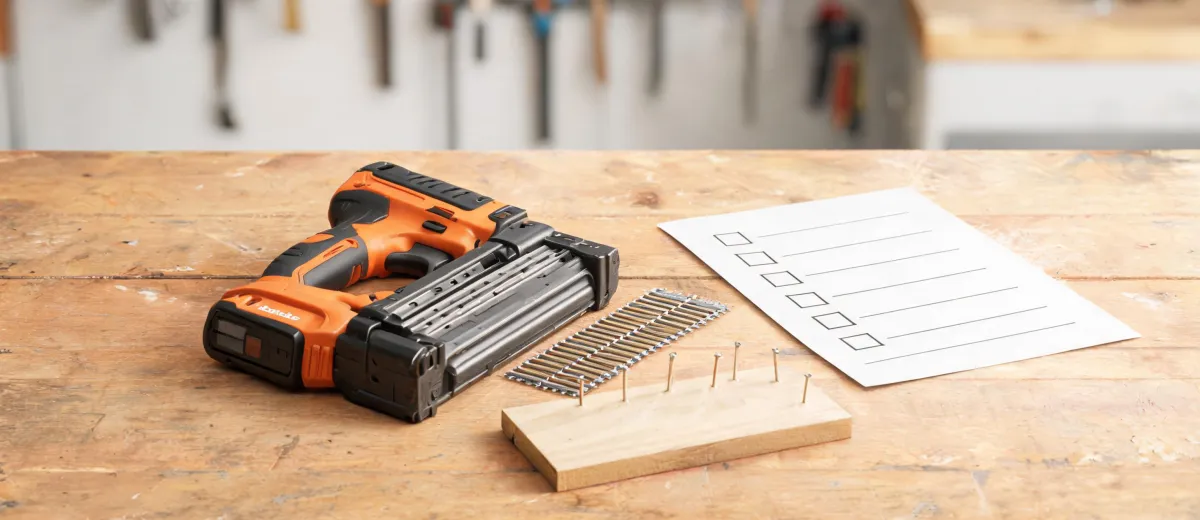
If you buy a Paslode nail gun by sticker price alone, you are probably not saving money—you are just delaying the cost. That sounds harsh, but it is what our tool budget taught me. I am a procurement manager at a 42-person framing and finish carpentry company. I have managed our tool and consumables budget ($310,000 annually) for seven years, negotiated with 14+ vendors, and documented every order in our cost tracking system. When I audited our 2024 spending, the highest-priced cordless framing nailer we bought was also the lowest total-cost tool in its category. The cheapest one—the one that looked good on the quote—was not.
This is not a pitch for spending more. It is an argument for updating an old procurement habit. What was best practice in 2020 may not apply in 2025. The fundamentals of jobsite cost control have not changed, but the execution has transformed.
The sticker price is not the cost
When I search paslode nail gun for sale, I see the same thing every contractor sees: a range of prices, bundle options, fuel cells, batteries, and claims about performance. The mistake is treating that first number as the purchase decision. In our TCO spreadsheet (i.e., not just the unit price but all associated costs), a nailer has at least six cost buckets: acquisition, fuel and batteries, fasteners, maintenance, downtime, and resale or replacement.
In 2023, I compared two cordless framing nailer packages for a three-crew expansion. Vendor A quoted a Paslode kit at $529. Vendor B quoted a lower-priced brand at $449. I almost went with B until I calculated TCO. B used a different fuel-cell format, required a separate battery platform, and had a 19-day average parts lead time in our region. Over 18 months, the $80 upfront gap turned into a $1,140 difference per crew. That is not a rounding error.
I should add that we were not replacing all pneumatic tools. Pneumatic nailers still make sense in the shop and on high-volume production walls. This is not about declaring one system obsolete. It is about matching the tool to the job and counting the real cost.
Why the Paslode 900420 cordless IMCT framing nailer changed our calculation
The Paslode 900420 cordless IMCT framing nailer is a good example of the shift. On paper, it is a cordless gas framing nailer. In practice, it changed how our crews sequenced work. We no longer had to drag hoses across finished floors, wait for compressor pressure, or keep a generator running for a single framing repair. That matters when you are paying four carpenters by the hour.
When I compared our 2023 pneumatic-only setup and our 2024 mixed cordless setup side by side—same crews, same jobs—I finally understood why the cordless Paslode was not the expensive option. It was the cheaper one after downtime. The savings showed up in small blocks: 12 minutes here, 20 minutes there. Across 11 months, that was roughly 170 labor hours we did not lose to setup and hose management. If I remember correctly, our loaded labor rate was around $68 per hour, though I might be misremembering the exact burden after benefits. Even at a conservative $55, that is over $9,000 in recovered capacity.
Even after choosing the Paslode 900420 for our framing crews, I kept second-guessing. What if the fuel cells were a hassle? What if the battery platform became a headache? The three weeks until the first full billing cycle were stressful. Then the numbers came in. Fuel and battery cost per driven nail was higher than pneumatic air cost, yes. But total cost per installed framing nail was lower because the crews moved faster and wasted less time on setup.
The hidden costs nobody puts on the quote
Quotes rarely include the cost of interruption. They list the tool, maybe a battery, maybe a case. They do not list the compressor maintenance you avoid, the hose replacement you skip, or the trips to the rental yard when a pneumatic gun goes down on a Friday afternoon. They also do not list the cost of training. A new cordless platform requires a reset in muscle memory. That is real.
That free setup offer actually cost us $450 more in hidden fees on a different tool order. Since then, our procurement policy requires quotes from three vendors minimum and a TCO line for every tool over $300.
For the Paslode system, the consumables are the cost center. Fuel cells have shelf life and temperature limits. Batteries degrade. Nails must match the tool and application. According to Paslode's published operating instructions, fuel cells and batteries are consumables with specific storage and handling requirements—not set-and-forget items. OSHA 1926 Subpart I is also blunt about this: power tools must be used according to the manufacturer's instructions, and operators need training. That is not a flaw. It is a budget line. If you ignore it, you will think the tool is expensive. If you track it, you can plan around it.
One more thing: screws still matter. Cordless nailers do not eliminate fasteners. They shift when and where you use them. In our finish carpentry work, screws are often the right call for cabinets, blocking, and hardware. A framing nailer does not replace a screw gun. It changes the sequence so the screw work is not delayed by a compressor or hose run.
What about cordless hammer drills with vacuum and cordless drill use?
A cordless hammer drill with vacuum is not a nailer replacement, but it belongs in the same TCO conversation. If your crews are already carrying batteries for nailers, sharing a battery platform can cut the number of chargers, spare batteries, and adapters you buy. That reduces clutter and cost. It also reduces the chance that a tool sits idle because the only battery is on the wrong charger.
So what is the cordless drill used for on a framing or remodeling jobsite? Quite a lot. It is for pilot holes, ledger attachment, anchor setting, mixing thin-set or paint, driving screws, and drilling through engineered lumber when nails are not the right fastener. A hammer drill with vacuum is especially useful for overhead concrete or masonry dust control, but it does not drive framing nails. The mistake is buying a drill to do a nailer's job, or buying a nailer to do a drill's job. They are complementary tools.
When we rebuilt our tool kit in Q2 2024, we stopped thinking in categories and started thinking in tasks. Framing nails: Paslode 900420. Screws and pilot holes: cordless drill or impact driver. Concrete anchors: hammer drill with vacuum. This task-based approach made the budget clearer. It also stopped the crew from borrowing the wrong tool and damaging it.
The objection: cordless gas nailers cost more upfront
This is the fairest objection, and I will not pretend it is wrong. The upfront cost is higher. Fuel cells are an ongoing expense. Batteries add to the kit. If you drive 200 nails a week, the math may not favor cordless. If you are a solo remodeler doing occasional framing, a pneumatic nailer and a small compressor may be the better financial choice.
But for professional contractors running crews, the calculation changes. Downtime is expensive. Setup time is expensive. Tool sharing is expensive. When you add those costs, the paslode system often wins not because it is cheap, but because it is predictable. Predictability has a price, and it is usually lower than chaos.
I want to say our fuel cell cost was around $5 to $6 per cell in early 2025, but don't quote me on that; pricing moves. What I can quote is our internal number: after 11 months, the Paslode 900420 crews had a 7% lower total cost per completed framing task than our pneumatic-only control group. That included fuel, batteries, nails, maintenance, and labor recovery. It did not include the intangible benefit of not hearing a compressor run all day.
My conclusion
If you are searching for a paslode nail gun for sale, do not start with the lowest price. Start with the job, the crew, and the cost of interruption. The Paslode 900420 cordless IMCT framing nailer is not the right tool for every contractor. No tool is. But for professional contractors who already pay for downtime, the lowest sticker price is often the most expensive habit.
The industry has evolved. Cordless gas technology, better batteries, and task-specific tools have changed what a smart tool budget looks like. The old rule—buy the cheapest tool that meets the spec—still has a place. It just should not be the only rule. Track the TCO. Count the hidden costs. Then decide. That is how you save money without pretending the purchase price is the whole story.

Omar Vukovic
Omar Vukovic is an independent garden and outdoor power equipment analyst covering pruning shears, loppers, hedge shears, lawn mowers, tillers, chainsaws, and related cutting systems. He applies IEC 62841-4 safety principles while comparing blade geometry, chain speed, bar length, cutting capacity, battery runtime, vibration, kickback controls, noise, ergonomics, and maintenance access. His practical articles help landscape teams and buyers choose equipment for vegetation, workload, operator control, serviceability, and seasonal operating conditions.