Why Small Contracts Deserve the Same Tool Quality as Big Builds (And How I Enforce It)
Small Jobs, Same Standards—That's Non-Negotiable
I don't care if your project is a $400 deck repair or a $40,000 framing job. You deserve the same structural integrity, the same tool reliability, and the same spec accuracy. Full stop.
I've been a quality and brand compliance manager in the building materials space for going on seven years now. My job is to review every deliverable—roughly 200+ SKUs annually across fasteners, cordless nailers, and accessory kits—before it goes to a customer. In our 2024 Q1 audit, I rejected 14% of first-article samples because the spec tolerances were off, the material certificates didn't match, or the packaging claimed something the product couldn't deliver.
Here's what bothers me: I see the same double standard everywhere. Big contractors get white-glove spec consultation. Smaller outfits—the one-truck operations, the remodelers, the guys doing exterior door replacements on a Tuesday afternoon—get told to "just grab whatever's on the shelf."
That's lazy. And frankly, it's bad for the industry.
The Cordless Nailer Argument: Proven on Jobsites of Every Size
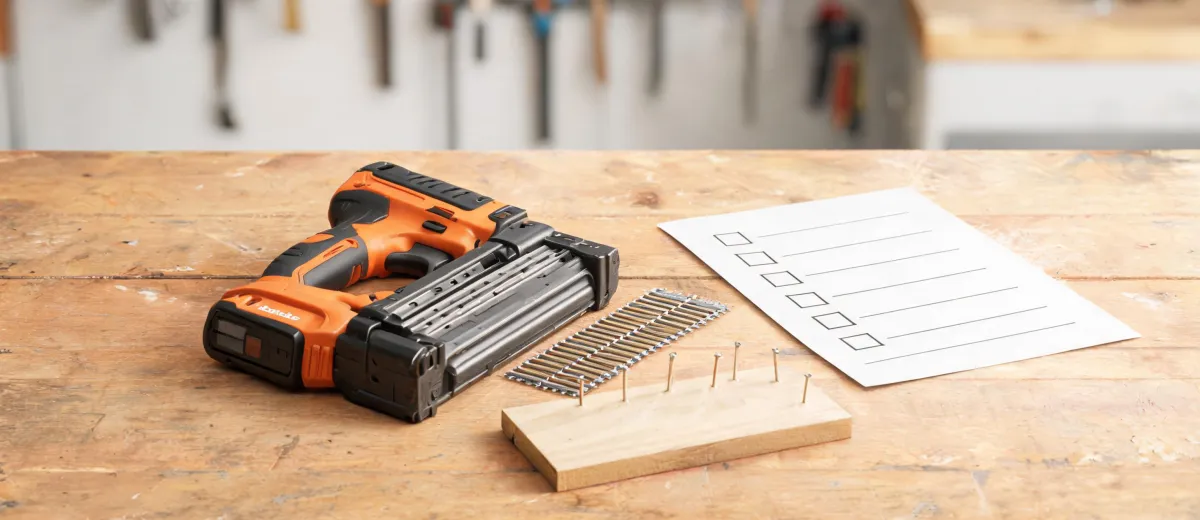
Take the Paslode cordless nail gun platform. When the first gas-powered cordless framing nailers hit the market, the pushback was predictable: "Real framers use pneumatic." "Cordless is for punch-list work."
That was true 15 years ago when battery technology and fuel cell consistency weren't there yet. Today? A Paslode battery nail gun like the CF325Li or the IM90Xi can drive 9,000+ nails on a single charge and fuel cell combo. I've seen crews frame entire garage walls without dragging a hose.
The old logic—cordless is for light duty, pneumatic is for production—that's legacy thinking from an era when cordless meant underpowered. That's changed.
What hasn't changed is the quality expectation. A Paslode nailer either sets the nail at the right depth or it doesn't. The fuel cell either delivers consistent combustion or it doesn't. And guess what? The guy framing a small cabin in rural Vermont has the exact same need for consistent depth as the crew building a 40-unit apartment complex.
Fastener Details That Break Small Projects (And How to Get Them Right)
Let me get specific. Three things I see go wrong on smaller jobs consistently:
Joist screws. For deck ledger boards and structural connections, you can't just use any 3-inch screw. You need a structural wood screw with the right shank diameter, thread design, and corrosion resistance. I've seen a deck fail because someone used drywall screws on a ledger board (which, honestly, I wish I could say was rare). For treated lumber, you need hot-dip galvanized or stainless—not electroplated. That's a spec, not a suggestion.
Exterior door hinge screws. This is the one that trips up even experienced remodelers. What size screw for exterior door hinge? Most standard residential hinges use #9 x 3" screws for the frame side, but if you're replacing a door in an older home, the frame may have been drilled for #8 or even #10. And exterior doors need longer screws—3 inches minimum—to reach through the door frame and into the structural framing. A 3/4-inch screw that only bites the jamb is a security risk and a sag risk.
Ratchet maintenance. A 3/8 ratchet repair kit isn't glamorous. But when your ratchet slips mid-job because the pawl spring is worn, you're losing time and knuckle skin. I keep a rebuild kit in every truck box. It's a $15-20 part that saves a $60 tool replacement and an hour of frustration. That's the kind of math small crews understand.
The Objection: "Why Not Start Cheap and Upgrade Later?"
I hear this a lot. The argument is: small contractors should buy budget tools first, prove they're serious, then invest in professional-grade equipment.
I reject that framing entirely.
First, the cost of failure on a small job is proportionally higher. If a $40,000 job goes sideways, you might lose your margin. If a $4,000 job goes sideways because your nailer misfired or your screws weren't rated for treated lumber, you might lose your business. Small operators don't have the reserves to absorb rework.
Second, the "prove yourself" logic assumes that small contractors are somehow less skilled or less deserving. That's nonsense. The guy who's been doing kitchen remodels for 12 years knows more about finish carpentry than a lot of production framers. He just happens to work on smaller projects.
And third—this is the part that really gets me—I've seen vendors do this. I've seen a supplier quote a small order at a higher per-unit price and deliver seconds-quality material because they assumed the customer wouldn't notice or wouldn't complain. That's not business. That's exploitation.
What I Tell Every Contractor Who Asks
I can only speak to my experience in the building materials sector and my own quality review processes. If you're working in a different trade or a different market, some of this may not translate directly. But here's what I've learned:
Specification knowledge is your best defense. Know what screw size your hinge actually requires. Know what fuel cell your nailer needs. Know the difference between structural and non-structural fasteners. I don't have hard data on how many jobs fail because of fastener substitution, but based on the warranty claims I've reviewed over five years, my sense is that it's a significant chunk—probably 20-30% of preventable failures.
And if a supplier makes you feel small for ordering small? Walk. There are vendors out there who will treat your $200 order with the same respect as a $20,000 order. Those are the ones worth building with.
Because here's the thing: today's small contractor with a $200 order is tomorrow's general contractor with a $200,000 account. The vendors who understand that—who don't discriminate based on order size—they're the ones who grow with their customers.
That's not charity. That's just good business.
"Small doesn't mean unimportant. It means potential."
So the next time someone tells you to "just use what you've got" on a small job, remember: your standards don't scale with your invoice size. Spec it right, tool it right, and don't let anyone convince you that professional quality is only for the big guys.

Amara Nwosu
Amara Nwosu is an independent hydraulic tool and pump systems analyst covering jacks, cylinders, pullers, torque wrenches, hand pumps, power pumps, and porta-power equipment. She applies ISO 4413 safety principles while examining rated pressure, cylinder force, stroke, oil volume, flow, return type, hose condition, load holding, pressure loss, and relief protection. Her technical guides help maintenance and construction teams configure compatible systems, verify safe capacity, and diagnose slow or unstable operation.