Paslode Repair or Replace? An Honest Cost Comparison from a Framing Crew Manager
-
Paslode Repair or Replace: The Comparison I Wish Someone Had Given Me in 2018
-
What I'm Comparing (and Why)
-
Round 1: Three-Year Total Cost of Ownership
-
Round 2: Downtime Is Where the Real Money Goes
-
Round 3: Real-World Performance on Site
-
Round 4: Parts, Consumables, and the Stuff That Sneaks Up on You
-
So — Repair or Replace?
Paslode Repair or Replace: The Comparison I Wish Someone Had Given Me in 2018
I've been running framing crews for 11 years now. And if there's one thing nobody told me when I started, it's this: the sticker price of a nail gun is almost meaningless. The real cost — the one that shows up in your quarterly numbers — is repair, downtime, and consumables.
I learned that the hard way. In March 2019, we were pushing through a tight residential framing schedule, and I hadn't done any preventive maintenance on our Paslode guns in about five weeks. Of the six guns on that job, four went down in the same week. One just quit firing. Three started jamming intermittently. That mistake cost roughly $1,200 in rework and overtime, plus about $480 in repairs. But the real damage was the two days of schedule slip that made our client start asking questions.
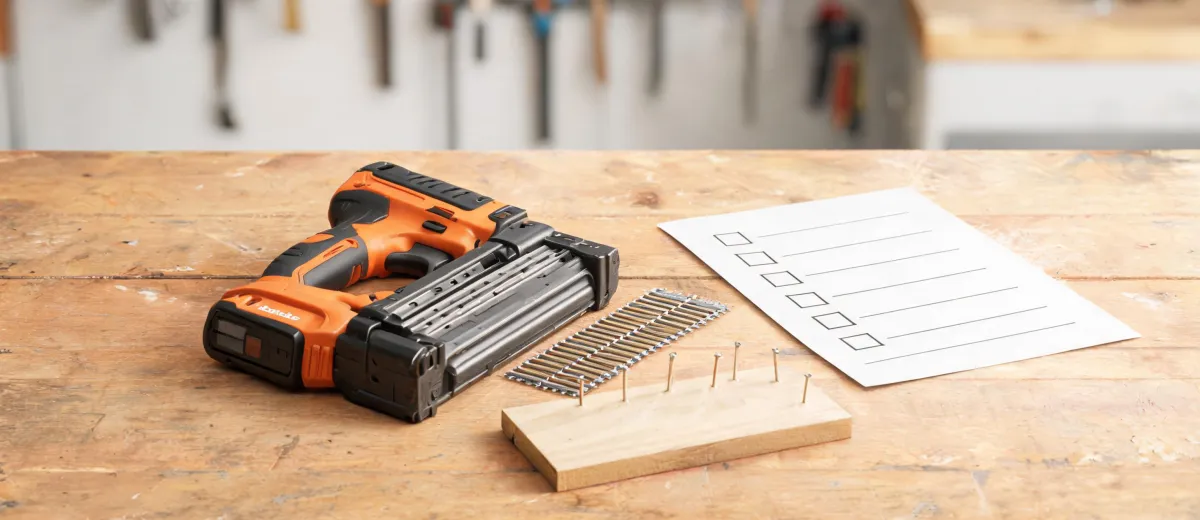
After that, I built a simple weekly checklist. We've caught at least 37 potential failures since then (as of January 2025, at least) — and that checklist has become the single most valuable document our crew has.
So when people ask me "is Paslode the best nail gun?" or "should I repair mine or buy new?" — I don't give them a one-word answer. It depends on which Paslode platform you're dealing with. The most honest comparison I can make is gas cordless vs. battery cordless. Same brand, very different ownership stories. Here's how they actually stack up.
What I'm Comparing (and Why)
Before the breakdown, let me be clear about the framework:
- System A: Paslode gas cordless nailers (think IM90i and similar platforms)
- System B: Paslode lithium-ion battery cordless nailers (newer line)
I'm judging them across four things that matter to any working crew:
- Three-year total cost of ownership (not just purchase price)
- Repair frequency and, more importantly, downtime severity
- Real-world performance on site
- Parts, consumables, and long-term support
Why these four? Because I've wasted money ignoring all of them at one point or another. Take this with a grain of salt — I run a mid-size operation, mostly residential framing and light commercial. If you're doing heavy industrial or a ton of interior finish work, your math might look different.
Round 1: Three-Year Total Cost of Ownership
Let me start with the number everyone stares at first.
A gas Paslode framing nailer — say a reconditioned IM90i — runs about $500 to $600 upfront (this was the going rate in Q4 2024, so check current pricing). Fuel cells and lubrication add roughly $180 to $220 per year for a crew that fires 800+ nails a day. Over three years, you're looking at $1,150 to $1,400 all-in.
Battery Paslode nailers are a different animal. The bare tool might be $400 to $500, but you also need batteries and a charger. Add roughly $250 to $300 for a two-battery starter kit. Replacement batteries run $100 to $150 each. And here's the part that surprised me — lithium-ion packs start fading after 18 to 24 months of daily hard use. We had three batteries go soft within 18 months on our first batch. That's $300 to $450 in replacement cost that gas users never see.
My honest take: If your daily volume is low — a few hundred nails — battery is cheaper upfront and probably cheaper long-term. But once you're firing 1,000+ nails a day, the gas platform's total cost of ownership tends to win out, mostly because fuel cells stay consistent while battery performance degrades quietly.
Round 2: Downtime Is Where the Real Money Goes
This is where the comparison gets interesting, and honestly, where the numbers genuinely surprised me.
Gas Paslode guns break in predictable ways: fuel system clogs, ignition issues, piston/cylinder wear. The upside? They're mechanically simple. Anyone who can turn a wrench can usually diagnose and swap a piston kit.
Battery Paslode guns fail differently — battery degradation, motor wear, control board problems. Fewer moving parts, but more electronics.
We tracked our own repairs across 18 guns from 2022 to 2024. Here's what came out:
- Gas units: 3.2 repair events per gun, per year
- Battery units: 1.8 repair events per gun, per year
So battery guns break down less often. Case closed, right? No.
Here's the nuance nobody talks about: the nature of the downtime is completely different. When a gas gun fails, it's usually a hard stop — it just won't fire. But the fix is often quick. A field repair with a $60 piston kit and 20 minutes gets you running again.
When a battery gun fails, it's often gradual — it slows down, misfires more, then quits. And the fix usually means shipping the unit back or finding a specialist. We had a control board replacement cost us $180 in parts and four days of downtime. The gun was under warranty. Didn't matter.
My surprise conclusion: Battery guns need fewer repairs but hit harder when they do. Gas guns need more attention but let you stay productive on your own terms.
Round 3: Real-World Performance on Site
This is where you stop reading spec sheets and start listening to the guys carrying the tools.
Gas Paslode framing nailers — like the IM90i — have one massive advantage: they're always ready. No air hose. No battery anxiety. Fire 6 a.m. cold. Finish 6 p.m. hot. On exterior framing, that matters.
That said, fuel does mean fumes. On indoor work, in a tight utility closet, that smell gets noticed. Battery units won't ever have that problem. Quieter too. That's a real comfort win.
Something else — the M16 nail gun (a Paslode model many first-timers confuse with a generic term) is a heavy-duty framing stick nailer. It's a different machine from an IM90i. Larger magazine, different nail collation, higher fuel appetite. If you run it on the same maintenance schedule as a smaller finish nailer, you'll be repairing it inside of six months. I've watched that happen twice.
Personally, I keep gas for framing and battery for trim. That split works for us.
Round 4: Parts, Consumables, and the Stuff That Sneaks Up on You
Nobody thinks about this until it's 2 p.m. on a Friday and you need a part by Monday.
Gas Paslode pros:
- Fuel cells are everywhere — Home Depot, Amazon, local fastener suppliers
- Bulk pricing is real; buy in trays of 12
- Service kits for cylinder and piston are widely stocked
Battery Paslode cons:
- Older battery models get harder to source every year
- Control boards often require factory service
- Motor replacement frequently approaches the cost of a new tool
One thing I'll say loud and clear: most Paslode repair issues I've seen were operator-induced, not factory defects. Dirty fuel systems, dropped tools, improper storage, overloaded duty cycles. Fit a proper maintenance rotation into your crew rhythm and your failure rate drops hard.
And a quick tangent for the pneumatic holdouts — because I know you're still out there. If you're running a compressed air system alongside your cordless tools, the little stuff matters. A Paslode TS4N5 air compressor is a solid quiet unit, but if you don't keep pressure in the right band, you'll starve your nails and stress your guns. Same thing with valves — a globe valve on your air line is designed for flow regulation, and its name comes from the spherical body shape that forces fluid through a tight throttle. When it wears, pressure drops. Nobody yells about the globe valve. But that's the point. Small losses compound into bigger problems.
So — Repair or Replace?
After six years of tracking this stuff, here's my not-perfectly-precise rule of thumb:
- Repair gas Paslode guns when the cylinder is sound and the fuel system is clean. A $70 piston kit on a two-year-old IM90i is a no-brainer. Fix it.
- Replace gas guns when you're looking at $300+ in repairs on a unit older than five years. At that point you're funding a refurb rather than an asset.
- Repair battery guns only if the issue is battery-related. Swap the pack, keep going.
- Replace battery guns if a control board or motor fails out of warranty. The repair bill usually crosses 40% of new tool cost, and that math never gets better.
And for the folks asking "is Paslode the best nail gun?" — I'd argue Paslode is the best gas-cordless platform I've used, and a strong battery option for trim work. But "best" only means something when you define the job. High-volume framing? Gas. Interior finish? Battery. Mixed crew? Own both and stop arguing.
The truth is, I lost money because I treated buying a nailer as a one-time decision. It's not. It's a maintenance program. Pick the platform that fits how you work, then commit to keeping it alive. That shift — from buyer mindset to owner mindset — is what fixed my repair numbers. Not switching brands. Not chasing a sale price. Just respecting the tool.
Bottom line: the cheapest nailer in year one is rarely the cheapest in year three. Count the downtime, not just the invoice.

Victor Salcedo
Victor Salcedo is an independent fastener, anchor, and spring analyst covering screws, bolts, nuts, washers, rivets, anchors, compression springs, extension springs, and torsion springs. He uses ISO 898-1 property classes alongside clamp-load, thread engagement, proof load, corrosion exposure, anchor substrate, spring rate, travel, and fatigue-cycle checks. His engineering explainers help designers and buyers specify reliable joints or elastic elements, compare materials and finishes, and avoid mismatched strength assumptions.