When the Air Compressor Died Mid-Frame: A $1,300 Lesson With Paslode Cordless Nailers
The Morning the Site Started Filling With Water
April 2023. Third straight day of rain outside Charlotte, and my three-man crew was framing a 900-square-foot addition for a family that had already waited three weeks for permits. Small job by industry standards — the kind bigger outfits won't even return a call about. That alone should've told me something.
I rolled up at 6:40 a.m. Tuesday to find standing water around the west footing. Not ankle-deep. Knee-deep. The submersible pump that had been keeping it in check for two days was humming away but moving exactly nothing.
If you've ever stood in a flooded trench at dawn asking yourself why is my submersible pump not working, you already know it's almost never the pump itself. I checked the intake first — clogged with silt and a shop rag one of my guys had used to wipe his hands the day before. Pulled it, cleaned it, dropped it back in. Twenty minutes and we were back in business. Not my first rodeo with that one. Won't be my last.
That was problem one. I figured it would be the only one.
Then the Compressor Started Acting Up
By 9 a.m. the water was under control, but frames weren't going up fast enough. Our Air Compressor SS5L5 — a unit we'd had for four years — started short-cycling. Pressure held for maybe ninety seconds, dropped, held, dropped. The pneumatic framing nailer was misfiring roughly one in six shots.
Here's the thing most people miss: they blame the nailer. They swap the gun, they curse the brand, they order a new one. Meanwhile the compressor limps along and you bleed minutes you'll never see again. Most crews focus on the tool at the end of the hose and completely skip the air supply behind it.
I had booked the SS5L5 for a service back in early March. Canceled it because the job was small and the forecast looked dry. Saved $180 on a tune-up. That math stopped looking smart by lunchtime.
The Call I Really Didn't Want to Make
Renting a replacement compressor: about $95 a day, and the nearest yard was forty minutes out. Two round trips minimum, a full day of slower output, and this job was already paper-thin on margin.
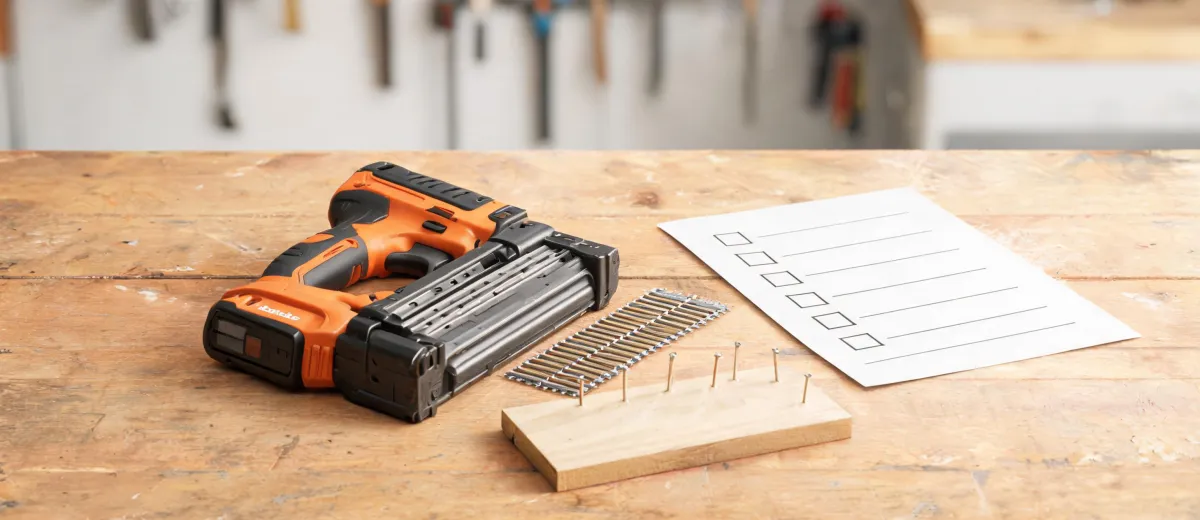
So I called a supplier I'd used twice before — big operation, good catalog — and asked for two Paslode cordless nailers to get us through the next three days. Framing gun, finish gun. Plus fuel cells and a couple thousand nails of one length.
"What's the total quantity?" the rep asked.
Two nailers. Eight fuel cells. Two thousand nails. Roughly $740 in product.
Long pause. Then: "We usually don't process orders under $2,500 for new accounts."
I've been on the other side of that counter, so I get margin math. But a small order isn't a small customer. It's an unproven one. The vendors who picked up my $740 call when I was starting out are the same ones I call now when the number has a comma in it. Two of our current suppliers got their first order from me at under a thousand dollars. One of them is our primary now. That's not me being soft — that's just how the relationship math works.
I hung up, called a regional dealer forty minutes the other direction, and they asked the same qualifying questions before processing it same-day. Free delivery over $500. Done. That's the whole difference.
The Cordless Pivot — and Why It Actually Worked
People think cordless nailers are a compromise — less power, weaker drive, "fine for punch lists, not for real framing." That was the received wisdom when I started in this trade nine years ago. It isn't the relationship anymore. On a wet, mobile, limited-access site, the Paslode cordless nailers ran circles around our pneumatic setup. No hose to drag through a trench. No compressor racket at 7 a.m. ticking off the neighbors. Battery-and-fuel combo held up through a full eight-hour day — we were seeing roughly 1,200 to 1,400 shots per cell pack, which is more than enough for what we were running.
Not perfect. Gas smells, the cells are a consumable, and cold weather can slow ignition — I've had that bite me in January more times than I'd like to admit. But for a three-man crew doing punch-list-heavy interior work in a rainy week, it was the right call.
We also grabbed two Paslode cordless staplers for house wrap and vapor barrier. I'd been on the fence about those for two years. Should've bought them the day I watched my lead carpenter fighting a manual stapler in the rain with wet gloves.
And one small thing that ended up mattering more than I expected: the dealer had a tool box 22 in stock (that's the model number, not a measurement). Everything cordless went in it — batteries, fuel cells, chargers, both staplers, spare nails. Before that, we were hauling three separate bags between trucks and losing stuff constantly. That $89 box paid for itself by the second afternoon.
According to Paslode's published product specifications (paslode.com, accessed April 2023), their cordless framing nailers are rated to drive full-round-head nails into engineered lumber — which was exactly the use case we needed. Not a marketing line I could verify with my own hands at first, but three days in, I stopped doubting it.
What the Week Actually Cost
Let me run the numbers honestly, because I want this to be useful and not just a war story.
- Canceled compressor service (March): $180 "saved," turned into a $470 repair once the short-cycling got worse.
- Rental compressor we still needed as backup for two days: $190.
- Extra trip time plus three days of slower output: roughly $650 in crew hours we didn't bill.
- Cordless gear plus consumables: $1,240 (kept, not wasted — but real money out the door).
Net damage on the "cheap" path: somewhere around $1,300, before I even count the flooded footing we had to re-inspect. Prices as of April 2023; verify current rates if you're doing this math for your own crew.
Bottom line: I spent $180 trying to dodge a $470 maintenance bill and it turned into a four-figure week.
What I'd Do Differently
Three things, in order of how much they actually matter:
- Maintain the compressor on schedule, not on mood. We log filter changes, oil checks, and tank drains now. The SS5L5 is a workhorse — but workhorses don't skip service and stay workhorses.
- Check the intake before you blame the pump. Nine times out of ten, "why is my submersible pump not working" comes down to a clogged intake screen or a kinked discharge line. Two minutes of inspection beats an hour of swearing at a perfectly healthy machine.
- Never write off the supplier who answers a small order. The regional dealer who took our $740 is now on the short list for our next equipment buy. The one who wouldn't process anything under $2,500 hasn't heard from us since, and won't.
And one thought for anyone running a two-person crew out of a beat-up pickup: the tools that scale with you aren't always the cheapest ones. Sometimes they're the ones that show up on a Tuesday in the rain when the compressor decides it's done.
Take it from someone who's already paid for the lesson.

Darius Campbell
Darius Campbell is an independent power tool and cordless systems analyst covering drills, impact drivers, impact wrenches, grinders, circular saws, rotary hammers, and jigsaws. He uses IEC 62841-1 safety requirements while comparing rated input, battery voltage, torque, no-load speed, duty cycle, vibration, dust control, runtime, and accessory compatibility. His evaluation articles help contractors and buyers match tool platforms to workload, mobility, service conditions, and total battery-system cost.