The Paslode CF325XP Cordless Framing Nailer: A Quality Inspector's Verdict
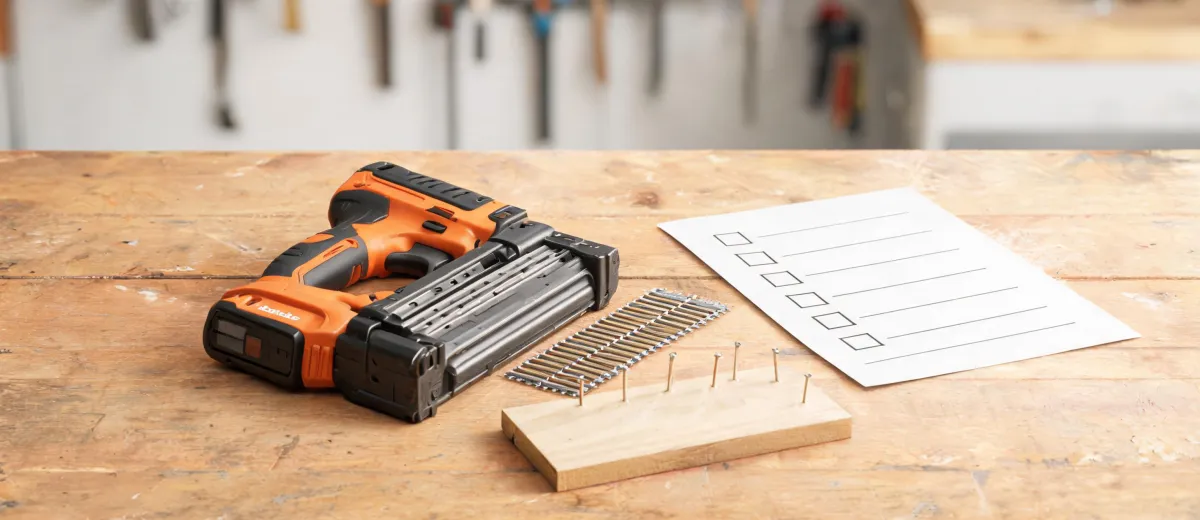
If you're framing for a living, the Paslode CF325XP cordless framing nailer earns its price within the first few months. If you're wondering whether you need a nail gun for brad nails, the answer is probably no. Both statements come from four years of testing nailers against documented pass/fail criteria in my role, not from brand marketing. The first is about a system that solves a real production problem; the second is about a tool category most users never truly need. I'll justify both conclusions below, and I'll also tell you where the CF325XP doesn't fit—because the edges matter as much as the verdict.
I run quality and brand compliance for a construction hardware distributor on the East Coast. I review every tool model before it reaches customers—roughly 40 to 60 unique SKUs a year. I write the pass/fail criteria, I sign off on first articles, and I reject deliveries that don't meet spec. In 2024, I rejected 11% of first deliveries from vendors for specification drift: magazine misalignment, depth adjustment failure after 2,000 cycles, fuel cell latch issues. I don't have brand loyalty; I have a rejection log. The CF325XP appears in that log less often than almost any other cordless nailer we carry.
What a 10,000-Fastener Test Actually Reveals
I've run three separate CF325XP units through our protocol: 2-inch through 3-1/4-inch structural nails, magazine reloads between every 30 shots, depth adjustment changes between every 500. The magazine feeds reliably—which sounds like a low bar, but it's the most common failure point in cordless nailers. Cheaper units jam progressively as magazine spring tension declines; the Paslode keeps consistent pressure through the whole cycle. The depth adjustment holds position after repeated impacts. And the battery/fuel cell interface stays sealed, which matters because dust infiltration ruins more tools than wear (in my experience).
One counter-intuitive finding for anyone comparing: the CF325XP is not lighter than a decent pneumatic framing nailer. It feels heavier on the bench. The cordless advantage is not weight—it's deployment speed. No compressor, no hoses, no extension cables, no generator if the site has no power yet. On rough framing, that setup-time saving is real. On a ladder, hose management is what slows a crew down, not the weight of the gun. That's the thing reviewers often miss.
Do I Need a Nail Gun for Brad Nails?
Short answer: for most people, no. I'll be direct because you're probably comparing products right now. Brad nails are 18-gauge trim fasteners, typically 5/8- to 2-inch. They leave holes small enough to avoid filling, which is why trim carpenters love them. But the question "do i need a nail gun for brad nails" only makes sense if you actually have a volume of trim work and a specific finish quality requirement.
A hammer and a nail set handle a dozen casing joints in about fifteen extra minutes per room—free, quiet, and controlled. A $99 corded electric brad nailer covers intermittent trim work without spending $300–500 on a gas or battery unit you'll touch a few times a year. The way I see it, a professional trim carpenter should own an 18-gauge brad nailer, honestly; a general contractor or homeowner mostly doesn't need one. And for finish work, the CF325XP is the wrong category anyway (though, honestly, I understand the appeal of a jobsite that runs on one fuel system).
Paslode Nail Guns for Sale: How Channel Changes Risk
When people search "lawn mowers for sale near me," the intent is local convenience—see it, haul it, use it today. That logic does not transfer to nail guns. For Paslode nail guns for sale, the buying channel matters more than the distance, because the gun is part of a system: fuel cells, battery packs, fasteners, rebuild kits.
- Authorized distributors carry the whole system and know which battery packs pair with which gun (Paslode changed battery formats across generations, so this genuinely matters). They stock rebuild kits and handle warranty questions directly; that's worth more than a small price difference, in my experience.
- Big-box stores sometimes have aggressive pricing on the gun alone. But the staff often can't tell you which fuel cell matches your unit, and I've seen first-time owners return working tools because nobody explained the battery needed an initial charge.
- Marketplace listings carry the highest risk. We've evaluated grey-market units where the fuel cell regulator was configured for a different region, changing combustion behavior. The listing wasn't malicious; the supply chain simply wasn't controlled.
The "near me" instinct makes sense for a self-contained machine like a lawn mower. A nail gun needs after-sale support, so the better question is "who near me supports this system?"
Fasteners Matter: The Anchor Story
Here's something tool reviews rarely mention: the gun is only half the system. We inspect consumables with the same rigor as the tools. Take something as ordinary as the ribbed plastic anchor kit 373517 in our catalog. That kit is spec'd for drywall and hollow-block installations where pull-out resistance depends on the anchor ribs gripping the substrate. We once received a batch of "equivalent" anchors where the rib height was about 0.02 inches off spec. The vendor called it "within industry standard." We rejected the entire lot.
Why? Because on a 50,000-unit installation contract, a 0.02-inch rib difference is the difference between anchors that seat firmly and anchors that spin free when the screw engages. It cost us $18,000 to reorder and reset a delivery schedule (a delay that, frankly, still embarrasses my quarterly reporting). That experience taught me never to assume "compatible" means "identical"—whether for anchors or for Paslode-compatible nails. Use the genuine fuel cell and fasteners, and the tool performs as documented. Mix brands, and you become the unpaid quality lab.
The Honest Price Math
Per FTC guidelines (ftc.gov), performance claims must be substantiated, and I use that framework when I read spec sheets. Paslode markets the CF325XP as a cordless professional framing system. In our testing, a fuel cell drives roughly 1,200 nails (at $7–9 per cell), and a battery charge lasts about 2,000–3,000 drives. So a full cost-per-fastener calculation has to include the tool, the fuel cells, a spare battery, and eventually a rebuild kit. The honest arithmetic is that the CF325XP costs more per nail than a pneumatic system with an inexpensive compressor.
The transparent question is not "which nail gun is cheapest" but "which system has predictable costs—tool, consumables, and downtime—over three years?" Paslode's advantage is consistency, not cost.
There's something satisfying about a tool that passes the full protocol with zero field failures. After the stress of that anchor reorder, a clean test report feels like a rare win. In my opinion, the CF325XP earns its reputation because its behavior is predictable—which means the cost estimate you make on day one stays true in month twelve.
When to Skip the CF325XP
No tool is universal. The boundaries:
- Sub-freezing jobsites. Fuel cell efficiency drops in cold weather; you'll change cells more often. It still works, but budget for it if you work winters in the Midwest or Northeast.
- Roofing and siding crews. A coil pneumatic nailer is still faster and more consistent for those shot patterns.
- Fine finish and cabinet work. For pin nails and delicate trim, an 18- or 23-gauge specialist is the right tool. A framing nailer has no business next to a mitered crown joint (surprise, surprise).
- High-volume indoor production. If you have reliable power and a compressor, pneumatics still win on cost per thousand nails. The cordless premium only pays off when setup speed and mobility are the actual bottlenecks.
The way I see it, you're not choosing between Paslode and "brand X." You're choosing for your work environment. If your jobsite is a blank lot and the first task is framing, the CF325XP is one of the few tools I'd approve without hesitation. If your work is trim, repairs, or occasional partitions, skip it—and skip the brad nailer question entirely until the job count justifies the purchase.

Maren Jorgensen
Maren Jorgensen is an independent hand tool and torque applications analyst covering wrenches, pliers, screwdrivers, hammers, sockets, ratchets, hex keys, and tool sets. She applies ISO 6789-1 torque-tool conformance principles while examining jaw capacity, leverage, fastener engagement, torque range, accuracy, handle geometry, and material hardness. Her practical guides help tradespeople and procurement teams select suitable tools, plan controlled tightening, and compare durability without relying on brand reputation alone.