What a Broken Paslode Siding Nail Gun Taught Me About Real Cost
Friday, January 17, 2025, 2:40 p.m. I remember the time because I was closing my laptop for the weekend when the phone rang.
“Do we have another coil siding nailer on site?” Derek asked.
“Why?”
“Because this Paslode just started skipping nails. We’re down to one gun.”
To give you the background, I manage procurement for a commercial exterior contractor outside Columbus, Ohio. At full strength we’re about 44 people on the tools—maybe 46 if you count the office staff, I’d have to check the roster. Over the last seven years I’ve managed roughly $300,000 a year in materials, fasteners, and small tools, and I track every order in a simple spreadsheet.
Derek was the lead foreman on Barclay Place, a four-story wood-frame building. We had a hard dry-in deadline: January 28. On the other side of that date, the metal panel contractor was scheduled to start, and our contract carried a $500 per-day penalty if we handed over the building late. In an Ohio January, weather windows are short enough; a broken nailer only made things worse.
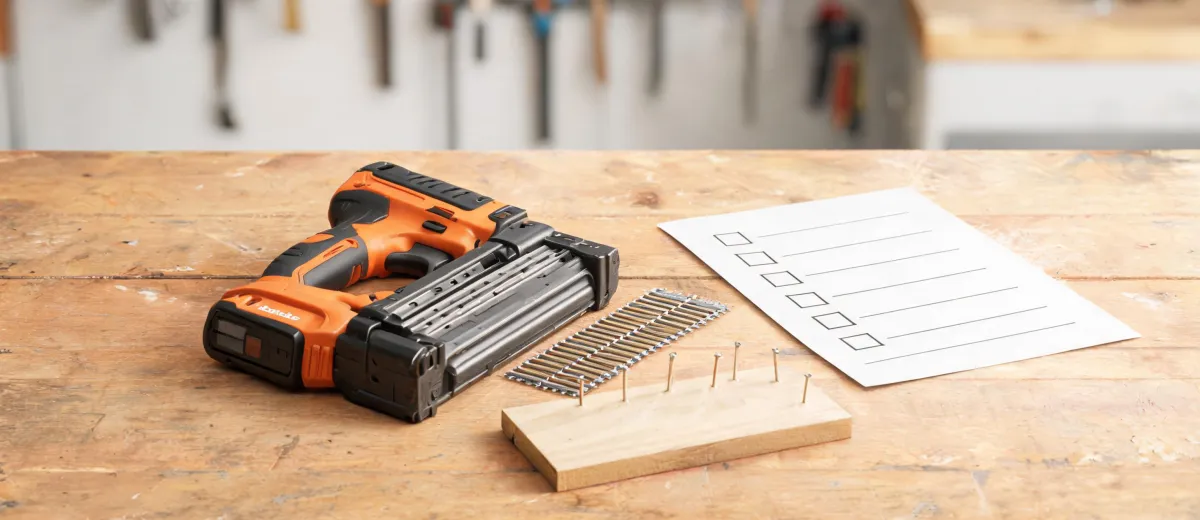
The siding crew started the week with two coil siding nailers. One, an older Paslode model, went into the repair shop on January 9. That left the crew relying on our primary tool—the Paslode pneumatic coil siding nailer 515900. When that one began double-feeding and skipping fasteners on Friday afternoon, we suddenly had zero working Paslode siding nail guns on the project.
The Repair Trap
My first instinct was to repair the 515900. It has been a dependable tool since we bought it in 2022. But when I pulled up the repair history, things got complicated. We’d already spent about $314 on that gun in 2024—no, wait, that total included the compressor service; the nailer-specific cost was around $212. Either way, the unit had paid for itself.
The real problem was time. The repair shop quoted a rebuild at roughly $240 and said it would be ready around January 30. That was two days after our deadline. Sure, we could keep the repaired unit as a spare afterward, but it couldn’t be the solution for this job.
It’s tempting to think the repair-versus-replace decision is simple arithmetic. If the repair costs less than a new unit, you repair. But that ignores the calendar. When a deadline is fixed, a repair that arrives late is not a repair; it’s just an expense.
As if to underline the point, Derek texted me a photo of a disassembled air hammer. “Need the air hammer parts diagram before Monday,” he wrote. Somewhere between finding that diagram and ordering the seals, I realized the entire week was becoming a lesson in what downtime really costs.
Two Options, One Deadline
By Saturday morning, I had two realistic options.
The first was to order a brand-new Paslode pneumatic coil siding nailer 515900 from our distributor. The quote came to $435 for the tool plus $32 freight—$467 total, with delivery by Tuesday, January 21. As of January 2025, that was the best price from our regular suppliers; prices change, so verify current quotes before ordering.
The second option was sitting in a local supply house: an open-box coil siding nailer from a different manufacturer. Nothing was visibly wrong with it. The store would sell it for $284 with a 90-day replacement warranty, and I could take it with me that afternoon.
Yes, the spread was only $183. And yes, I went back and forth for two days. The open-box unit offered lower price and immediate pickup. The new Paslode 515900 offered a full warranty, known service history, and predictability—the same model our crew had run for years. I ultimately chose the Paslode, but not because I’m loyal to any brand. I chose it because of a simple calculation.
Our dry-in penalty was $500 per day. A delay caused by one nail gun would also mean idle crew time, reshuffled schedules, and possibly a weekend makeup day with overtime rates. One half-day of lost production would have cost more than the $183 difference. Even a 20% chance of that outcome made the discount a bad bet. When the downside is that large, “probably fine” is not a strategy I want to explain to a general contractor.
The Real Cost of Certainty
Monday morning, I ordered the 515900. It arrived Tuesday at 9:55 a.m., exactly when promised. The crew set it up, and for the next six days it behaved the way a workhorse nailer should—no jams, no skipped fasteners, no apologies. That may sound like a low bar, but in construction, a tool that quietly does its job for a week is worth more than one that occasionally steals the show.
Barclay Place was dried in on January 28. The repaired older gun came back on January 30, and we racked it as a spare. The air hammer went back into service once we ordered the right parts; that took a bit longer than expected because the first air hammer parts diagram I pulled was for a newer revision, but that’s a separate story.
People sometimes ask me what is the best type of cordless drill, and they expect a model number. I understand why, but I don’t think that question has a universal answer. On most days, a drill is low-stakes: if one dies, you grab another from the gang box and keep going. A Paslode siding nail gun against a hard deadline is different. The real cost isn’t the tool; it’s the time when the tool stops working.
I should add that the same logic doesn’t apply everywhere. For example, the TM3000CX5 multi tool set we keep in the trim van was bought on price. It combines several functions at a reasonable cost, and if one attachment fails, nobody is paying us a penalty. Cheap is fine when failure is cheap.
But on deadline-driven projects, I now ask a different question instead of “which price is lower.” I ask: what happens if this tool fails on a Tuesday? If the answer makes me uncomfortable, then the cheaper option isn’t cheaper. In early 2025, that question led us to a new Paslode 515900. It wasn’t the lowest invoice. It was the lowest total cost—at least, that’s been my experience on work where the calendar doesn’t move.

Maren Jorgensen
Maren Jorgensen is an independent hand tool and torque applications analyst covering wrenches, pliers, screwdrivers, hammers, sockets, ratchets, hex keys, and tool sets. She applies ISO 6789-1 torque-tool conformance principles while examining jaw capacity, leverage, fastener engagement, torque range, accuracy, handle geometry, and material hardness. Her practical guides help tradespeople and procurement teams select suitable tools, plan controlled tightening, and compare durability without relying on brand reputation alone.