48 Hours to a Walkthrough: A Paslode Pneumatic Finish Nailer, a 30-Degree Paslode, and One Read Manual
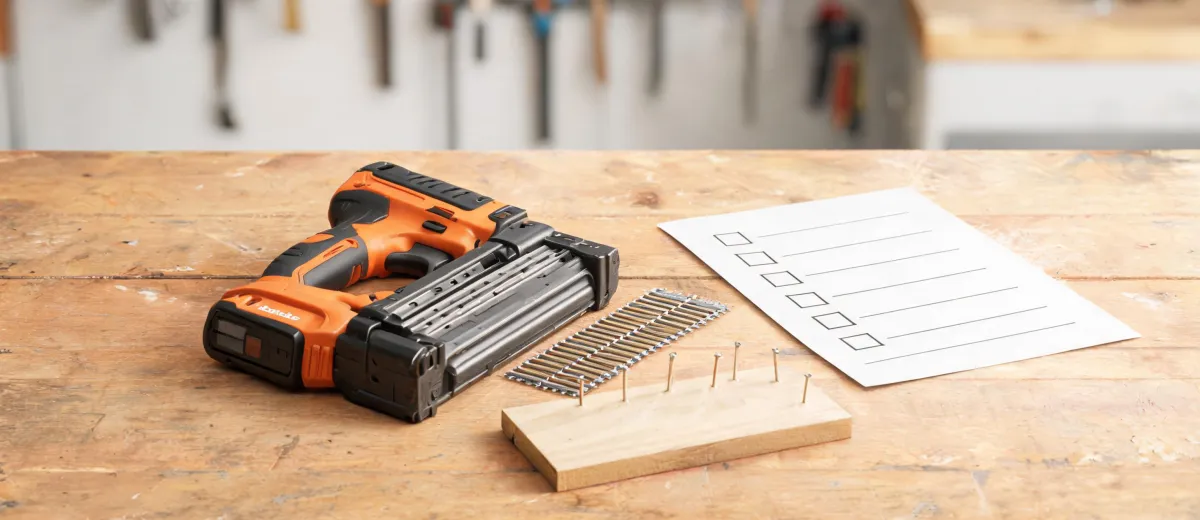
The call came in at 4:12 on a Tuesday. I remember the time because our shop was closing in forty-eight minutes and a fourteen-unit townhome project had a final walkthrough scheduled for Thursday at 4:00 p.m. That left roughly 48 hours, minus whatever time we wasted trying to understand what the crew needed.
In my role coordinating rental and repair equipment for contractors, I've handled more than 60 rush jobs in the last five years—maybe closer to 70, I'd have to count. Some are repeat customers; some are one-time frantic calls. This one was Rita, a site manager who did not have time for small talk.
Rita had two problems. The first was trim. Her crew had a Paslode pneumatic finish nailer in Unit D, and it was sending 16-gauge nails halfway into the casing before quitting. The crew chief kept saying the compressor was dying. The second problem was a framing repair in Unit F: a partition wall needed to be rebuilt before drywall and trim could continue. Her email said, 'Paslode nail gun 30 degree for partition.' I read that twice because angle matters.
The air pressure problem
When I asked Rita to describe the compressor, she said it was an 80 gallon unit that had been moved from another building over the weekend. That detail turned out to be important. I asked her to find the 80 gallon air compressor manual that came with it. She texted me a photo from page 12, and there it was: after moving a compressor, check the regulator and pressure switch settings. The regulator knob had been bumped down to about 55 psi. The Paslode pneumatic finish nailer was marked to run from 70 to 120 psi, so the driver did not have enough force to seat the nail.
The fix took five minutes. We raised the regulator to around 100 psi at the hose, tested one nail, and it sank flush. The surprise wasn't the compressor. It was how small the correction was. If we had rented a replacement compressor, Rita would have paid for something she did not need and probably missed the afternoon window.
Why the 30-degree Paslode made sense
The second request was less dramatic but just as time sensitive. The repair wall in Unit F needed a 30-degree framing nailer because the crew had 30-degree paper tape collated nails on site. A 21-degree tool would have meant a different box of nails and a lot more sorting time. The Paslode nail gun 30 degree that we brought uses a fuel cell and a battery instead of an air hose. That made it useful in a way I did not fully appreciate five years ago.
The framing crew set it up without running a single hose. They built the partition while the trim crew kept using the compressor for the finish work in Unit D. No one waited for a spare connection. No one had to move the compressor halfway across the building. By early afternoon, the wall was framed, sheathed, and ready for drywall.
I used to think pneumatic was always the safer answer for framing, and I still respect it. A pneumatic nailer with a clean, dry air supply and enough volume is hard to beat for long, repetitive framing days. But the fundamentals haven't changed as much as the execution has. For emergency repairs and punch-list work, a cordless Paslode nail gun can finish the same job without the setup time. By 2024, I stopped automatically steering people to air when a deadline was tight and the site was messy.
Screws have a role too
There was one more small task on Rita's list that no nail gun could handle. A door casing in Unit B had separated at the hinge side. The trim crew wanted to shoot a finish nail through it, and I understand why: nails are fast. But on a casing that has already split, a nail can act like a wedge. It can open the crack further instead of closing it.
We used a box of Fas-n-Tite wood screws from the van. After a quick pilot hole, the screw pulled the casing tight and held it flush. Screws do not replace nailers in most trim work, but they should be part of any emergency kit. Sometimes the right fastening solution is not the most exciting one.
The finish line
By Thursday afternoon, Unit D had trim, Unit F had its repaired wall, and Unit B had a casing that would survive a close look. I did not stay for the walkthrough. The builder called at 5:10 p.m. to say it passed. Then Rita thanked us for not treating her like a nuisance. I have been on enough edge-of-the-cliff projects to know that a simple acknowledgment can matter as much as the repair.
One thing I could not help with that week was my nephew's group chat asking how to get nail gun bo6. I am not the person for video game unlocks. But if the question had been about a real nail gun, the answer would start the same way it did for Rita: know the angle, know the collation, and decide whether you need air or not. That approach beats any shortcut.
Looking back, the biggest lesson was not about the tools themselves. It was about diagnosing before replacing. Someone was ready to order a compressor rental because nobody had read the manual. Instead, one page of the 80 gallon air compressor manual saved the schedule, and the Paslode tools did what they were supposed to do.
One caveat: this happened in 2024, and equipment manuals get updated when models change. The pressure settings I mentioned are examples from that particular unit. Always confirm the regulator setting against your own 80 gallon air compressor manual and the markings on the tool itself.

Maren Jorgensen
Maren Jorgensen is an independent hand tool and torque applications analyst covering wrenches, pliers, screwdrivers, hammers, sockets, ratchets, hex keys, and tool sets. She applies ISO 6789-1 torque-tool conformance principles while examining jaw capacity, leverage, fastener engagement, torque range, accuracy, handle geometry, and material hardness. Her practical guides help tradespeople and procurement teams select suitable tools, plan controlled tightening, and compare durability without relying on brand reputation alone.