What 5 Years of Buying Paslode Tools for a Professional Crew Taught Me
-
Here's the Short Version
-
Why You Should Listen to Me
-
What I Assumed at First (and Got Wrong)
- What We Use Now: Paslode Cordless Nail Guns
-
The Same Lesson, Repeated: BRZ Ball Valves and the PC1010 Compressor
-
Can I Use a Drill Bit in a Router? No. Seriously, No.
-
What I Don't Know (and the Boundary of My Advice)
-
A Final Word on Prices
Here's the Short Version
If you're outfitting a professional crew and weighing Paslode cordless nail guns against cheaper options, here's the bottom line: the Paslode battery nail gun and the cordless framing nailer are worth the premium. But budget for the consumables, because fuel cells, batteries, and Paslode cordless lubricating oil add up way faster per year than the tools themselves.
And for the question I get from every new hire at least once: no, you can't use a drill bit in a router. I'll explain why in a minute—along with two other purchasing mistakes that cost us real money.
Why You Should Listen to Me
Quick background. I'm the office administrator for a 40-person construction and renovation company. I handle all tool and material ordering—roughly $250,000 a year across about 12 vendors. I report to both operations and finance, which basically means I get blamed when something's late and nobody notices when something works.
I've been in this role since 2020. That's five years of ordering nail guns, compressors, valves, and every random thing our crews swear they need. I've made expensive mistakes so you don't have to.
What I Assumed at First (and Got Wrong)
When I first started buying tools, I honestly thought a nail gun was a nail gun. The cheapest framing nailer that sinks a 3-1/2" nail into a stud seemed like the obvious buy. I ordered a budget brand from a wholesale catalog. It shot nails. The crew didn't complain for about a month.
Then the jams started. Then the misfires. Then one of the tools literally fell apart on a job site and we had to send two guys home early. The repair bills on three nailers over two years came to more than the tools cost. That's when I learned about total cost of ownership. The hard way, obviously.
Everyone warned me, too. Our site foreman told me to stick with Paslode from day one. I didn't listen. I thought he was just loyal to a brand he liked. Now I know better.
What We Use Now: Paslode Cordless Nail Guns
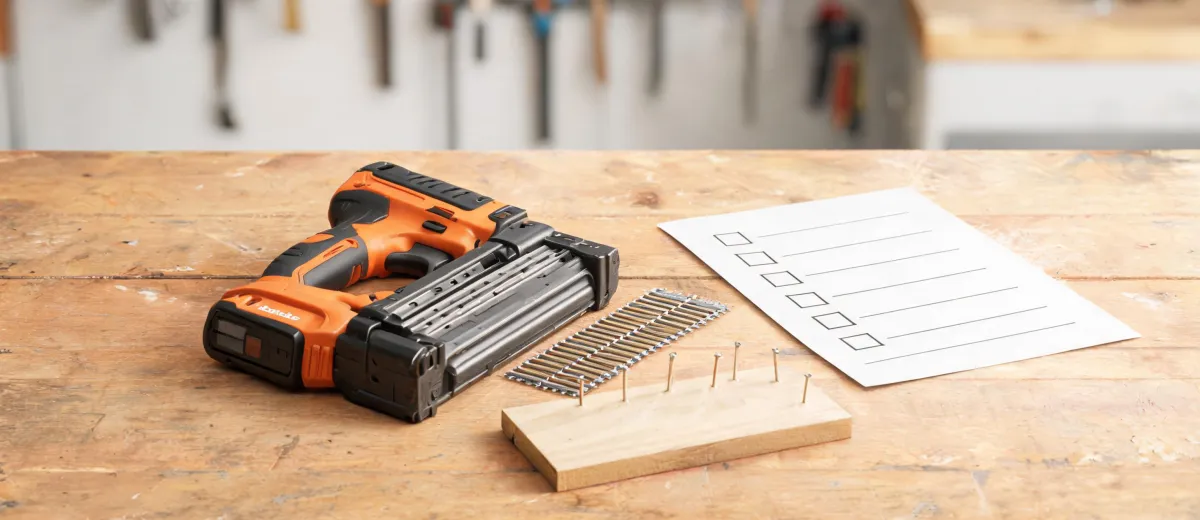
Our crew runs Paslode cordless framing nailers for framing work and the Paslode battery nail gun for finish trim. The cordless gas fuel cell technology is the main reason we switched—no compressor to drag around, no hose to trip over, and the tools work fine on ladders and scaffolds. The framing nailer is heavy—anyone who says otherwise is lying—but it sinks nails consistently all day without complaint.
The battery nail gun is what we grab for baseboards, casing, and crown. It's lighter, quieter, and the finish quality is honestly better than our old pneumatic setup. The nail guns themselves run in the $350-450 range depending on where you buy them. The real shock for most people is the accessories: fuel cells, batteries, and the specific maintenance products. Budget for all of it upfront.
The Oil Is Not Optional
Here's something I didn't know when I started: Paslode cordless lubricating oil is a real thing, and skipping it will cost you. I get why people assume it's a racket—"special oil" for a nail gun sounds like a money grab. It's not.
The air-powered Paslode tools need oil in the air line. The cordless gas tools have moving parts that need regular lubrication too. I ignored this for the first year because filling another oil reservoir seemed like a hassle. That decision led directly to a $380 repair on a finish nailer that was barely six months old.
The bottle isn't expensive—around $8-12 depending on the supplier. We now keep it in the same cabinet as the fuel cells so nobody has an excuse. One bottle lasts us about a month across a 40-person crew's fleet of tools. The cost is basically nothing compared to replacing a seized tool. Take it from someone who learned the expensive way: just buy the oil and use it.
The Same Lesson, Repeated: BRZ Ball Valves and the PC1010 Compressor
You'd think I'd learn the "cheap isn't cheaper" lesson once. Nope.
In 2023, our master plumber asked me to order ball valves for a commercial bathroom project. He specifically wrote down "BRZ ball valve" on the purchase request. I found a no-name valve online for maybe 55% of what the BRZ ball valve would cost and figured I was being a hero. He warned me the cheaper valves had a reputation for seizing. I ordered the cheap ones anyway.
Six months later, one seized shut and we had to shut off water to an entire floor of a building we were renovating. The plumber had to cut into a finished wall to replace it. The labor alone cost more than triple what I'd saved on the parts. The building owner heard about it. My name came up.
Now I order the BRZ ball valve every single time. I'd rather spend the extra $20-30 on the invoice than explain to my VP why a cheap part cost us $900 in labor and goodwill.
On the compressor side, we've had a PC1010 air compressor on the truck since before I started. That little unit has been abused—dropped, run in the rain, left on a trailer overnight—and it still works. The crews use it for pneumatic brad nailers and for blowing dust out of holes after drilling. It's not fancy, but it's one of the most reliable pieces of equipment in our fleet.
Here's the thing though: Paslode's gas tools are fantastic on job sites where you don't want a compressor, but they don't replace a compressor entirely. We still run pneumatic tools for certain tasks, and that PC1010 keeps earning its spot on the truck. Different tools for different jobs. That's not a knock on Paslode—it's just having the right tool for the task.
Can I Use a Drill Bit in a Router? No. Seriously, No.
This is the question that shows up in my inbox more than any other, and it's not just from homeowners. A new guy on our crew asked me once. I assumed he was joking. He wasn't.
The short answer: no, you can't use a drill bit in a router—and you shouldn't try. Here's why:
- Different shanks. Router bits come in 1/4" and 1/2" collets with precisely machined shanks. Drill bits have round shanks designed for chucks, and they're not uniform enough for a collet to grip safely.
- Different speeds. A router spins at 20,000+ RPM. A drill caps out at 2,000-3,000 RPM. Even if a drill bit fit, its cutting geometry is completely wrong for those speeds. It'll grab, chatter, or burn—worst case, it shatters.
- Side loads. Drill bits are built for downward pressure, not the sideways cutting forces a router applies during edge profiling. That sideways force can snap a drill bit mid-cut. Flying metal and spinning wood don't mix.
If you see someone on social media "hacking" a drill bit into a router, don't copy it. The "works until it doesn't" category is where injuries come from.
What you actually want, if you don't want to buy router bits: a rotary burr or carving bit with a 1/4" shank, designed for high-speed cutting. Those exist for specific tasks like freehand shaping and metal trimming. But for woodworking, just buy the proper router bit.
What I Don't Know (and the Boundary of My Advice)
Let me be honest about my limits. I'm a purchasing guy, not a tool technician. I can tell you what our crew reports, what our repair bills look like, and what's held up under real job-site abuse. I can't give you torque specs, engineering analyses, or detailed teardown comparisons. If you need that level of technical depth, there are people who do it much better than I can.
Here's also what I'd push back on: the idea that one brand does everything best. I've never seen that be true in five years of buying tools. Paslode makes excellent nailers—but I wouldn't buy their "everything" line if they made one. The BRZ ball valve is great for plumbing. The PC1010 air compressor is great for light pneumatic work. The router question is best answered by buying actual router bits. Specialist products beat generalist promises every time.
The vendor who says "that's not our strength—here's who does it better" has never lost my trust. The one who claims to make the cheapest everything usually loses it.
A Final Word on Prices
Pricing I've mentioned was accurate as of Q1 2025. The tool market changes fast, so verify current costs before you budget. This is especially true for Paslode fuel cells and battery-powered tools, where prices have shifted noticeably over the last year.
Also worth noting: if you're strictly using Paslode's cordless gas tools, the lubrication routine is different from a pneumatic setup. The fuel cell is pre-mixed and doesn't need oil in the gas line. But the nailer's moving parts still need regular maintenance with the right lubricant. Don't skip it.
If you've got a specific question about what to order for your crew, talk to a Paslode dealer—not just read forums from people like me. Dealers see what breaks, what comes back, and what gets reordered. That data is worth more than any single review.
Oh, and the drill bit thing? Seriously. Don't.

Maren Jorgensen
Maren Jorgensen is an independent hand tool and torque applications analyst covering wrenches, pliers, screwdrivers, hammers, sockets, ratchets, hex keys, and tool sets. She applies ISO 6789-1 torque-tool conformance principles while examining jaw capacity, leverage, fastener engagement, torque range, accuracy, handle geometry, and material hardness. Her practical guides help tradespeople and procurement teams select suitable tools, plan controlled tightening, and compare durability without relying on brand reputation alone.