Paslode Cordless vs. Pneumatic Framing Nailers: A Procurement Manager's Cost Comparison
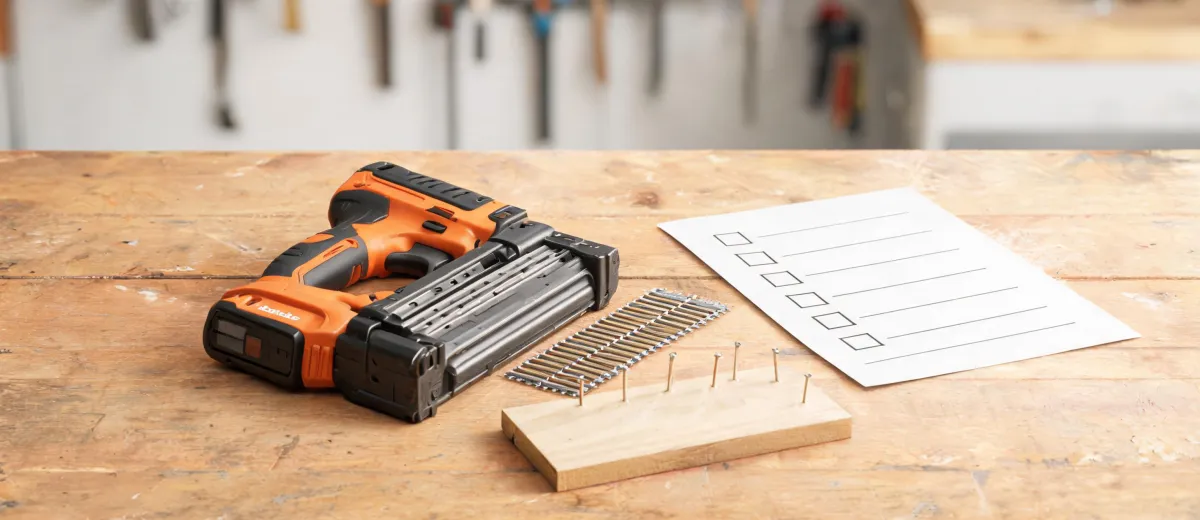
Six years of purchase orders and repair logs. That's what this comparison is based on. I'm a procurement manager at a 40-person construction company, and I've managed our tool and fastener budget—about $120,000 annually—for the last six years. I've documented every order, every warranty claim, and every hour a crew stood idle waiting on equipment.
Here's the question I keep getting: is the Paslode cordless framing nailer worth the premium over pneumatic? I'm not a tool engineer, so I can't speak to combustion chamber design or valve cycles. What I can tell you, from a cost-tracking perspective, is how the two systems perform when you calculate everything—not just the unit price. This isn't a brand loyalty thing either. It's a comparison of two ways to drive a framing nail: a pneumatic nailer running off a compressor, or a cordless gas-powered nailer using a fuel cell and battery (Paslode's territory, and they're the standard reference for it).
We ran both side by side across 20+ job sites over two years. Here's what the data showed.
The Comparison Framework: What I Actually Tracked
To make this useful, I compared the two systems on four criteria:
- Total cost of ownership—unit price, accessories, repair frequency, consumables
- Job-site time loss—setup, breakdowns, waiting on air
- Versatility—how many tasks each system handles (framing, finish, repairs)
- Hidden costs—the stuff that never shows up on the invoice
I left out brand loyalty and "my uncle swears by X" opinions. The spreadsheet doesn't care about stories.
Upfront Numbers vs. Total Cost of Ownership
Let's start with the obvious: pneumatic is cheaper upfront. A decent pneumatic framing nailer runs $250–$400. A Paslode cordless framing nailer (the model we standardize on) retailed around $379 as of February 2025, plus the battery and charger if you're starting from zero.
But here's where the "cheap" story falls apart. Pneumatic requires a compressor. A job-site-grade compressor costs $400–$800. Add hoses, fittings, oil, and the occasional regulator rebuild. Now the pneumatic "system" isn't cheap at all.
Never expected the budget option to get more expensive the longer we ran it. Turns out, when you factor in the compressor and the maintenance hours, the gap narrowed to almost nothing by year three.
Consumables matter too. Pneumatic runs on air—no fuel cells. Paslode fuel cells run about $7–$8 each, with roughly 1,200–1,400 shots per cell. For a crew firing 3,000 nails a week, that's around $15–$20 in fuel cells. Not nothing, but not the budget-killer people assume.
And the battery? The paslode cordless framing nailer battery is a lithium-ion pack that lasts a full day on one charge. We bought spares and cycled them. Actually, let me correct myself—we did have one battery failure in year two. Covered under warranty, but it happened. That's the kind of detail no one mentions in the marketing material.
The Cost of "Probably On Time"
This is the dimension I almost didn't track—and it turned out to be the most important one.
Here's a number I do not forget: in March 2024, we paid $400 extra for rush delivery on a specialized trim order. The alternative was missing a $15,000 installation deadline.
The $400 bought certainty, not speed. That's the lesson I apply to every tool purchase now.
A compressor is a "probably on time" machine. Usually it starts. Usually the hose doesn't leak. Usually no one runs over the line. But when a contractor's compressor goes down at 8 AM on a framing day, you don't get those hours back. The crew stands around being paid to wait.
I knew the compressor had been making that noise for a week. I thought, "what are the odds it dies on a Friday?" It died on Friday. That overconfidence cost us a full day of labor on a tight schedule.
With the Paslode cordless framing nailer, the failure mode is simpler. If the battery dies, swap it. If the fuel cell runs out, replace it. There's no motor to seize, no tank to leak, no hose to trip over. The tool is either loaded or it isn't. And that determinism has real financial value when you're managing a deadline.
I'm not saying pneumatic tools are unreliable. Most of the time, they're fine. But "most of the time" isn't the standard when a schedule penalty is on the table. The certainty premium is real.
Finish Work Changes the Equation
If you've ever run a finish line in an occupied space, you know the pain of dragging a hose across finished hardwood. This is where the paslode finishing nail gun earns its keep. Trim, casing, baseboards, cabinetry—the cordless gas system means no compressor noise, no hose marks, no setting up a tank in a client's living room.
Our finish crew switched to Paslode cordless finish nailers three years ago and hasn't looked back. Jobs are faster, job sites are cleaner, clients are happier. That last one isn't a line item on the spreadsheet, but it shows up in the reviews and the repeat business.
The framing side benefits too. A crew moving from floor to floor doesn't want to drag a compressor up a stairwell. The cordless framing nailer goes in the gang box, and the battery charges overnight. That's a workflow change, not just a spec sheet change.
Where Unit Price Distracts You
I've been burned by the cheap option too many times to count. A rookie foreman asked me once: why should a circular saw that does not get daily use still get a high-end blade? My answer: because when you finally need it, you need it to work the first time. The same logic applies to nailers—and honestly, to almost everything we buy.
One example: a team member wanted to add the 80966 243pc 6 pt. mechanics tool set to the shop order. It's a decent set for the price—243 pieces, six-point sockets, good bit selection. I approved it, not because we desperately needed it, but because it replaced a scattered drawer of mismatched sockets that cost us 20 minutes every time we hunted for a 12mm. The cheap tool isn't cheap when it fails at the wrong moment.
Same with fasteners. When I order consumables, I used to grab sheet metal screws in bulk because the unit price was slightly better. We ended up with a lifetime supply. Not a costly mistake, but it's the same mindset: unit price is the worst single number to look at. What matters is total cost per successful installation.
So What Should You Buy?
I can only speak to our situation: a mid-size contractor with predictable crews and a mix of framing and finish work. If you're a seasonal operation with demand spikes, the calculus might look different.
That said, here's the pattern that held up across our data.
When pneumatic still wins
- You're running a production shop with a permanently installed compressor
- You're firing thousands of nails daily, all day, every day
- You have a dedicated maintenance person (or you are that person)
- Weight matters more to you than setup time
Pneumatic tools are lighter than gas-powered cordless units. In a production environment, that weight difference adds up by end of day. If air is already on site, pneumatic is a sensible choice.
When Paslode cordless wins
- You're moving between job sites or floors constantly
- You do finish work in occupied spaces
- You can't afford a crew standing around waiting on air
- You budget for certainty, not just unit price
The premium for the Paslode system buys you one thing: the nail goes in when you pull the trigger. In our data, that reliability saved us roughly $8,400 annually once we priced in avoided downtime—about 17% of our tool and fastener budget.
If you're only looking at the sticker price, pneumatic wins. If you calculate what an hour of crew time costs when the compressor won't start, the cordless premium starts looking pretty reasonable. That's the time certainty premium, and it's worth every dollar on a deadline.

Maren Jorgensen
Maren Jorgensen is an independent hand tool and torque applications analyst covering wrenches, pliers, screwdrivers, hammers, sockets, ratchets, hex keys, and tool sets. She applies ISO 6789-1 torque-tool conformance principles while examining jaw capacity, leverage, fastener engagement, torque range, accuracy, handle geometry, and material hardness. Her practical guides help tradespeople and procurement teams select suitable tools, plan controlled tightening, and compare durability without relying on brand reputation alone.