The "Budget" Nail Gun Costs More Than a Paslode. I Track Tool Purchases for a Living.
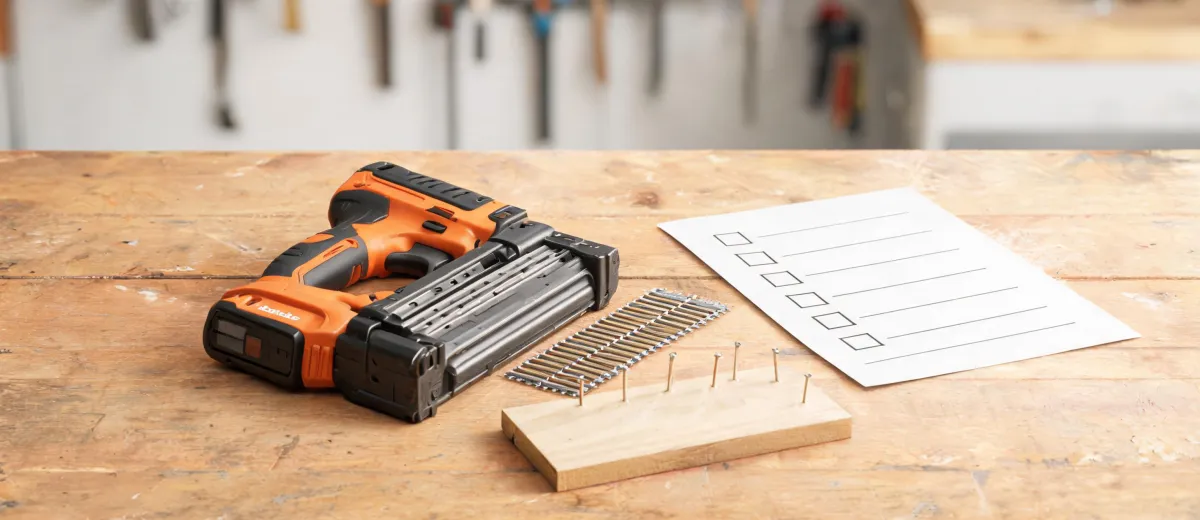
I'll say it straight: the "budget" nail gun is the most expensive tool purchase a small contractor can make. That sounds counterintuitive, I know, but I have six years of purchase data that says I'm right. I'm the procurement manager at a 35-person construction firm, which means I manage a tools and equipment budget of roughly $180,000 a year. I've compared quotes from 40+ vendors, documented every order in our cost-tracking system, and watched the same pattern repeat more times than I can count. This isn't brand loyalty. It's a spreadsheet.
People think the purchase price is the cost of a tool. It isn't. The real cost is total cost of ownership—TCO, if you like acronyms—which includes repairs, downtime, replacement, and the labor hours you lose when the tool doesn't work. And when you run the numbers that way, the "affordable" nailer is the most expensive thing in your truck.
Here's what I mean. When a tool fails on a jobsite, you don't just lose the tool. You lose the hour it takes to fix it, the hour it takes to replace it, and sometimes the client who watched it happen. For a small operation, that's the difference between a profitable month and a break-even one.
The Math That Kills the "Cheap" Nail Gun
Let me do a concrete comparison from my own purchase log. A budget cordless nailer from a big-box store costs around $120–$150. A Paslode cordless framing nailer—the 350 model, actually, the one that's been a jobsite staple for years—sits around $350 as of February 2025. On paper, the budget gun saves you $200. I get why that's tempting, especially for a solo operator.
But the budget gun starts jamming around week three, right when you're deep into an exterior wall. Clearing a jam costs 15–20 minutes. On a typical crew, that's $30–50 in labor, and I'm being conservative. Three jams and a misfire in the first month wipes out $110 of your savings. Then the gun starts feeding inconsistently, the warranty trip becomes a lost day, and you're back at the store looking at a replacement. The $200 you saved is gone, and you still don't have a tool that works.
I don't have hard data on industry-wide jam rates for budget nailers—nobody publishes that, understandably. But based on tracking maybe 40 tool purchases over six years, my sense is that budget nailers need at least three times more unplanned maintenance than professional-grade tools. What I can say for sure is that the pattern is consistent enough to build a budget around.
The Repair Kit Is the Whole Argument
Here's where the TCO math gets interesting. Professional tools are designed to be rebuilt. When a well-used Paslode loses its punch, you don't toss it. You order the Paslode 219235 F350 Power Master Plus repair kit—a part I've ordered more than once—and you rebuild it. The kit runs somewhere around $30–40 and takes maybe half an hour to install. After that, the nailer is back in service. We've got Paslode tools in our inventory that have been rebuilt two or three times and are still earning their keep.
What's the rebuild kit for a $129 budget nailer? Good luck finding one. The budget brand isn't selling you a tool; it's selling you a disposable object that costs 30% less than the real thing and lasts 30% as long. That's not a value—it's a loan.
Small Contractors Can't Afford Downtime
Now I'll get to the part that actually gets me fired up. Almost every contractor I've met who bought the budget nail gun was a small operator—a solo guy, a two-person crew, someone just starting out. And those are exactly the ones who can't afford the gamble.
I ran a one-man handyman operation for four years before moving into procurement. I've been the guy standing in the tool aisle, doing the cheap-versus-Paslode math in my head. And I've made the cheap choice before: I bought a budget finish nailer once because I needed it that afternoon, and I spent the next two weeks hating it every time it misfired. Looking back, I should have ordered the Paslode on Day 1. At the time, the $200 difference felt real.
When your business is small, you don't have redundancy. A big firm has backup guns, spare parts, a tool crib. You have what's in your hands. Every minute that nail gun isn't working is a minute you're not getting paid. That's not philosophical.
I see this clearly with the Paslode siding nail gun. Siding is punishing work—dust, weather, treated lumber, all-day runs. The subs I know who switched to the Paslode siding nailer stopped carrying a backup gun altogether. That's the highest compliment a tool can receive: total trust. A budget nailer doesn't earn that trust.
My experience here is based on working with maybe 50 subcontractors over the years, from solo guys to 50-person shops. I can't speak to how this applies to huge industrial contractors with full-time tool maintenance staffs. But for small operators—which is most of the market—tool failure hits disproportionately hard.
Same Lesson, Different Tools
This isn't a nail-gun-only principle. I apply the same TCO lens to everything I buy.
Take chainsaws. Last spring (circa April 2024, if I remember the order date correctly), I compared the 555 59.8-cc 2-cycle 24-in gas chainsaw against two cheaper alternatives. The budget saw was $180 less. But it had worse cold-start behavior and a vibration system that felt like a suggestion. I went back and forth for a week—the cheap one made sense on paper, but my gut kept saying the 555 was the one. I bought the 555. I've never once regretted it.
Same with pumps. I still remember pulling a submersible pumps price list from three suppliers to find the cheapest dewatering option. We bought the cheapest one, a no-name unit at 35% below the nearest brand. Six months later, the float switch failed, the pump ran dry, and the motor burned out. The warranty replacement was a disaster involving an unhelpful distributor and a manufacturer who might as well not exist. We spent the money anyway, plus a week of project downtime. The price list was a lie, technically. The TCO told the truth.
And while I'm on the topic of maintenance: one of our crew guys asked me last month, "can I use air tool oil in my compressor?" The honest answer is: you can pour it in, but it's not doing what you think. Air tool oil is for lubricating air tools, not the compressor pump. Using the wrong oil—or ignoring maintenance entirely—is how you turn a $400 compressor into a $900 replacement. It's the same shortcut mindset that drives budget nail gun purchases, and it has the same predictable outcome.
"I Can't Afford a Paslode" Is the Wrong Question
"Easy for you to say when you're spending corporate money."
Fair. I've heard that. But I've also been the solo guy with no budget, and I'm telling you: being small doesn't mean cheap tools are smart. It means the opposite. When you can't absorb a breakdown, you need the tool that won't break down.
And let me say one more thing about being a small customer in this industry. There are plenty of suppliers who act like a small order isn't worth their time. I've been ignored by vendors whose minimum order was apparently "more than you're buying." That's wrong. The vendors who took my $200 tool orders seriously back when I was solo are the ones I still order from today, when my purchase orders run into five figures. Treat people right when they're small, and they'll stick with you when they grow.
But a quality tool purchase doesn't require a bulk discount anyway. A Paslode costs the same whether you're a one-man crew or a national contractor. Nobody's out here price-gouging small operators on nail guns. The barrier isn't the supplier. It's the mindset that says "I'll save $200 now."
Here's the Bottom Line
The budget nail gun is the most expensive tool you'll ever buy. Not because it's evil, but because it fails. It costs you time, it costs you customer trust, and it gets replaced long before a Paslode would have even needed a part.
The Paslode costs more upfront. I won't argue with that. But it keeps working, it can be rebuilt with parts like the 219235 F350 Power Master Plus kit, and it's earned its reputation on actual jobsites through actual decades of use. That's not marketing. That's a spreadsheet. And I'll trust a spreadsheet over a sticker price any day of the week.

Maren Jorgensen
Maren Jorgensen is an independent hand tool and torque applications analyst covering wrenches, pliers, screwdrivers, hammers, sockets, ratchets, hex keys, and tool sets. She applies ISO 6789-1 torque-tool conformance principles while examining jaw capacity, leverage, fastener engagement, torque range, accuracy, handle geometry, and material hardness. Her practical guides help tradespeople and procurement teams select suitable tools, plan controlled tightening, and compare durability without relying on brand reputation alone.