Paslode Cordless Nailers vs. Pneumatic Nailers: What a Quality Inspector Checks
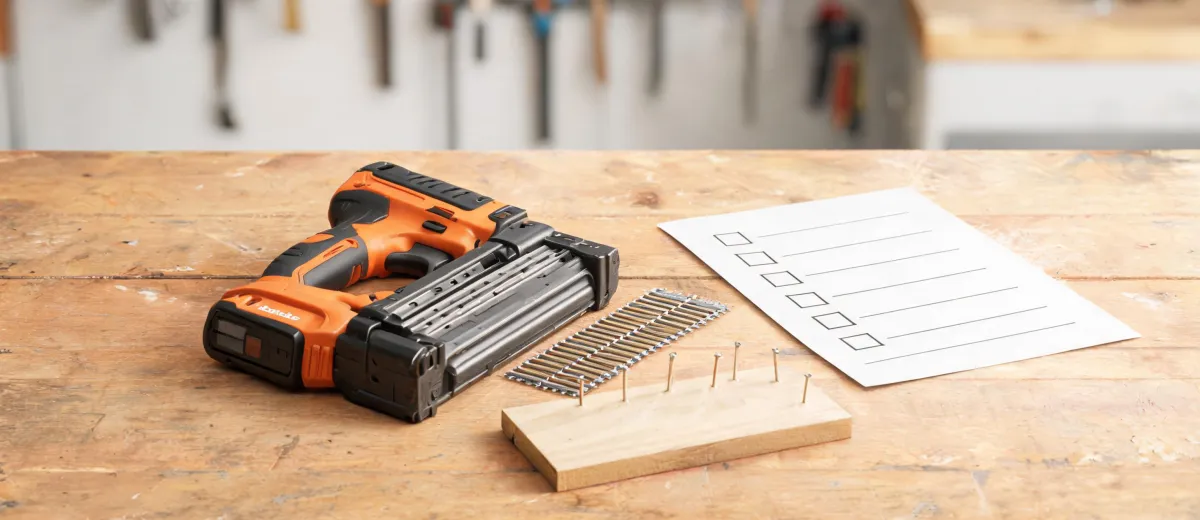
I'm a quality and brand compliance manager at a fastener and tool distribution company. I review roughly 200+ unique tool and fastener orders a year. In Q1 2025, I rejected 6% of first deliveries because a spec was off: wrong drywall screw, wrong socket profile, or a tool that didn't match the approved sample. Those rejections taught me one thing: comparing tools without a framework is how you end up with a truck full of expensive gear that doesn't fit the work.
So when someone asks whether Paslode cordless nailers are worth the hype, I don't give a simple 'yes' or 'no.' I compare the way I compare everything: setup, power, cost, fastener specs, and support tools. Here's the framework I use.
- Setup: How much time does it take to start working?
- Power: Can it drive the fastener to depth consistently?
- Cost: What does the real per-job cost look like?
- Fastener spec: Is the screw or nail actually right for the material?
- Support tools: Does the rest of the kit match the job?
Setup: Pneumatic vs. Cordless
Everything I'd read in my early years said pneumatic nailers were the professional standard. Then I spent a morning on a roof with a Paslode framing nailer and a pneumatic gun side by side. In practice, that standard shifts.
With pneumatic, setup is a checklist: compressor, hose, extension cord, fittings, and sometimes an air dryer. On a flat floor, that's fine. On a steep roof, it's a second person's job just to manage the hose. If you've ever dragged a hose up a ladder, you know that feeling.
Paslode cordless nailers use a gas fuel cell and a rechargeable battery. There's no compressor and no hose. The Paslode roofing nail gun is the same idea for coil roofing nails: you carry the tool, the nails, and one small battery. That's a serious setup advantage when the job moves around.
Setup conclusion: For mobility, cordless wins. For a nail gun that stays in one spot, the setup argument matters less.
Power and Depth: Closer Than You'd Think
The conventional wisdom says pneumatic drives harder. That sounds logical, but it's not what I've measured. When I put a Paslode cordless nailer against a good pneumatic with the same 3-1/2-inch framing nail and the same LVL material, both sank the nail flush. The cordless didn't struggle. The difference was consistency over time, not raw penetration.
Here's the thing about cordless gas nailers: the combustion chamber has to be maintained. If you don't clean it, the tool starts leaving nails proud. I've seen that happen more than once. It wasn't a bad tool—it was a skipped maintenance step. Pneumatics are simpler in that sense, but they're not maintenance-free either. They depend on the compressor, and I've lost more hours to dead compressors than to dirty fuel chambers.
Last spring, I ran a blind test with our crew: same collated nails, same material, two nailers. Six out of eight installers said the cordless felt smoother and left less recoil. That didn't prove it was stronger. But on a day of overhead work, perceived effort matters.
Per FTC guidelines (ftc.gov), if a brand claims 'professional-grade reliability,' that claim should be substantiated. My evidence after years of audits is simple: both systems can meet spec if you respect their maintenance windows.
The power verdict? Cordless isn't automatically weaker. It's automatically more finicky about maintenance.
Cost: Per Nail vs. Per Hour
The cost question is where people get stuck, and I get it. Paslode fuel cells are a recurring expense. If you're driving thousands of nails a day on a framing crew, pneumatic nails plus compressor electricity can be cheaper per fastener. I've seen the job cost sheets.
But per-fastener cost isn't per-project cost. Think about a three-day roofing job. A crew might spend 30 minutes setting up and tearing down the compressor each day. That's an hour and a half of paid labor. With the Paslode roofing nail gun, there's no hose to roll up and no compressor to load. The consumables cost more, but the labor saving often flips the comparison.
When I put pneumatic and cordless job cost sheets side by side, I finally understood why the 'pneumatic is cheaper' answer was too simple. For static production, pneumatic wins on nail cost. For high-mobility work, cordless usually wins on cost per hour.
Cost conclusion: Know which number you're optimizing before you buy.
Fastener Spec: What Length Drywall Screw for 1/2-Inch Drywall?
Fastener specs are where quality falls apart. One of the most common questions I hear is, 'What length drywall screw for 1/2 inch drywall?' Here's the short answer: for 1/2-inch drywall on wood studs, use 1-1/4-inch drywall screws. For 5/8-inch drywall, use 1-5/8-inch. For 1/2-inch drywall on metal studs, use 1-inch Type S screws.
People assume a longer screw means a stronger hold. In drywall, longer can mean worse. A 1-5/8-inch screw through 1/2-inch drywall can punch through the stud and nick a wire. It also makes it harder to seat the screw without tearing the paper. The 1-1/4-inch screw gives you enough thread in the stud and keeps the surface clean.
I learned never to assume this after our install crew bought a bulk box of 1-5/8-inch screws for a half-inch drywall job. We sent the entire batch back and lost a day. Now every contract includes the fastener length.
Fastener conclusion: Use the spec that matches the drywall thickness, not the longest screw in the truck.
Support Tools: Compact Drill and Impact Sockets
A nail gun is only part of a fastening system. If you're hanging drywall, you need a screw gun or drill. For overhead work, my crew keeps going back to the CXS 12 2.5-Plus cordless drill. It's compact, light, and has enough clutch control to sink drywall screws without blasting through the paper.
Compared to a full-size 18-volt drill, the CXS 12 2.5-Plus loses torque. It also wins on control and shoulder fatigue. For 1-1/4 drywall screws, that's the trade-off I'll take every time. For a spade bit through a stud, grab the big drill.
Sockets are the other hidden spec. A cheap socket can round off a bolt head, and then a two-minute job becomes a 20-minute extraction. After a few too many of those, I switched our shop to a full master impact socket set in SAE and metric sizes. Six-point impact sockets grab the fastener corners instead of the edges. You can feel the difference on the first use.
Support tools conclusion: Match the nailer to the job, the drill to the motion, and the socket to the torque.
So Which Do You Buy?
Here's the part that doesn't fit in a headline: it depends on where your crew works.
If you're framing production all day with multiple nailers running, a pneumatic system is still a solid choice. The per-nail cost is lower, and the tools are simpler to service. Keep a cordless Paslode around for punch work and quick fixes.
If you're a roofer, a remodeler, or a service contractor, Paslode cordless nailers make more sense. The Paslode roofing nail gun is easier to transport, faster to set up, and easier on the people climbing ladders. The trade-off is consumable cost and maintenance discipline.
Whatever you choose, don't ignore the specs around the nail gun. Use the right drywall screw length. Use impact-rated sockets. Use a drill that doesn't fight your wrist. I'd rather explain these trade-offs now than deal with a callback later. An informed customer is the best customer, and you're the one who has to live with the tool on Monday morning.

Maren Jorgensen
Maren Jorgensen is an independent hand tool and torque applications analyst covering wrenches, pliers, screwdrivers, hammers, sockets, ratchets, hex keys, and tool sets. She applies ISO 6789-1 torque-tool conformance principles while examining jaw capacity, leverage, fastener engagement, torque range, accuracy, handle geometry, and material hardness. Her practical guides help tradespeople and procurement teams select suitable tools, plan controlled tightening, and compare durability without relying on brand reputation alone.