What Type of Nail Gun for Trim and Baseboards? A Cost Controller's Deep Dive
The question that sounds simple
Every few weeks, a foreman asks me some version of the same question: What type of nail gun for trim and baseboards?
They want a model number. I used to give them one. That was a mistake.
I am the procurement manager for a 38-person construction company. I have managed our tool and fastener budget—roughly $240,000 annually—for seven years, negotiated with 40-plus vendors, and logged every order in our cost tracking system. When I audited our 2023 spending, I found something uncomfortable: the nailer itself was rarely the expensive part.
The expensive part was everything around it.
The surface answer is not wrong. It is just too small.
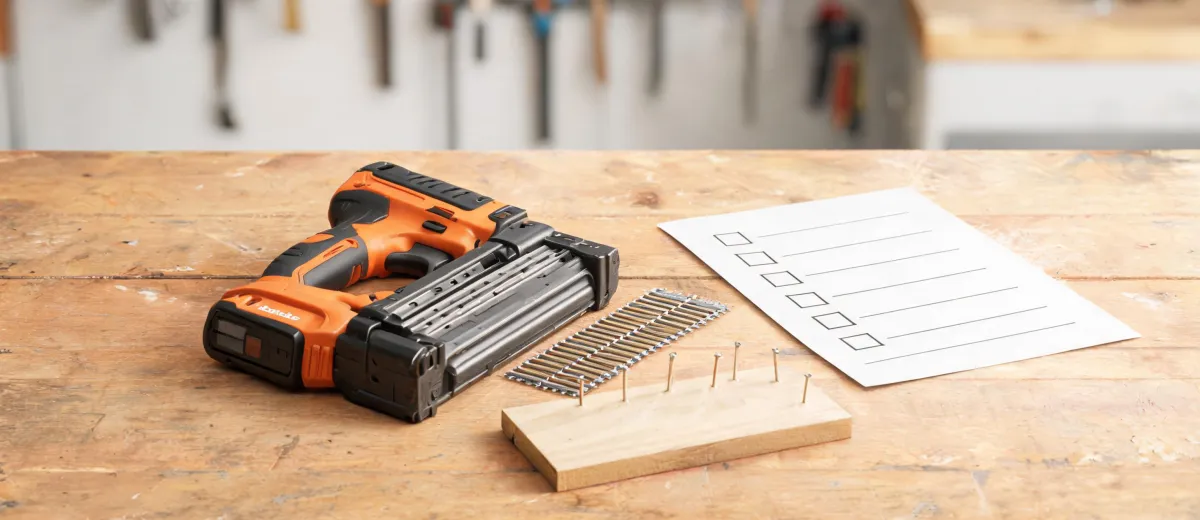
If you only need the quick answer, here it is: for most baseboards and door or window casing, you want a 15- or 16-gauge angled finish nailer. For shoe molding and quarter round, an 18-gauge brad nailer is usually enough. For thicker trim where an 18-gauge will not hold, step up to 15- or 16-gauge. The Paslode angled cordless finish nailer sits in that finish-nailer family—not in framing, not in roofing.
But that answer ignores the question underneath. Trim is not one material. It is not one thickness. And it is not one jobsite condition.
A baseboard in a production townhome is not the same as custom millwork in an occupied house. A casing package on a commercial buildout is not the same as crown molding in a remodel. The nailer has to match the trim, the substrate, the access, and the crew.
That is where budgets go wrong.
The deeper problem: you are buying a tool, not a fastening system
Here is the pattern I see. A crew needs to install baseboards. Someone buys a finish nailer. The tool works. Then the fuel cells run out. Or the battery dies. Or the wrong fasteners show up. Or the compressor trips because the air line is full of moisture. Or the nose leaves marks on prefinished trim. The tool was not the problem. The system was.
Every nailer belongs to a platform:
- Cordless gas. Paslode cordless tools use fuel cells and batteries. That is not a flaw. It is the trade-off for not dragging a hose. But fuel cells and batteries are consumables. They belong in the budget.
- Battery. Different battery platforms mean different chargers, packs, and replacement cycles. Mixing platforms across crews creates duplicate inventory.
- Pneumatic. An air compressor SS5 can run finish nailers and framing nailers in a shop or on a site with reliable air. But the compressor is only one line item. Hoses, fittings, moisture traps, filters, and maintenance are the rest.
I keep manufacturer-published application guides and operating manuals in our procurement folder. As of January 2025, the manuals for cordless gas nailers are clear: fuel cells and battery packs are required consumables. They are not optional. They are not free. And they are not something you discover on the second invoice if you have done the math first.
That is not a knock on the technology. It is a cost-control reality.
The assumption that cost me $1,200 in rework
I assumed a 15-gauge finish nailer was a 15-gauge finish nailer. I did not verify nose profile, depth adjustment, or fastener head geometry across brands. I just looked at the gauge and the price.
Turned out the trim crew was using prefinished maple. One nailer sank nails too deep. Another left crescent marks because the nose was not designed for that profile. We had to pull a run of casing, fill, sand, and refinish. The rework invoice was $1,200. The nailer was not the most expensive line on the job. The assumption was.
That is when I stopped treating nail guns as commodities. A finish nailer is a precision tool for a specific surface. If you are installing baseboards in a painted poplar house, your margin for error is different than if you are installing stain-grade oak in a custom home.
The surprise was not the tool price
Never expected the compressor to be the cheap part. Turns out the real cost was the air system around it—hose repairs, moisture traps, fittings, and the labor lost when nobody wanted to drag 100 feet of hose through a finished house.
We ran a test across two crews. One used a pneumatic setup with an air compressor SS5 and a finish nailer. The other used a cordless finish nailer. On paper, the pneumatic setup had lower fastener costs and a lower tool price. In practice, the cordless setup won on punch-list work. The pneumatic setup won in the shop, where air was already plumbed and the work was stationary.
The surprise was not the price difference. It was how much the jobsite layout changed the answer.
The cost of getting it wrong
I analyzed $186,000 in cumulative tool and fastener spending across six years. About 24% of our budget overruns came from mismatched nailers, fasteners, and platforms—not from the initial purchase price.
That number includes:
- Callbacks caused by nails that did not hold
- Rework from over-driven or under-driven fasteners
- Fuel cells and batteries bought at retail because inventory was not tracked
- Compressor downtime and moisture issues
- Duplicate tools because each crew solved the same problem separately
- Crew idle time waiting on the right fastener or the right battery
A low sticker price is not the same as a low job cost. Simple.
And the reverse is also true. A higher-priced tool can be the cheaper decision if it eliminates a callback, a second trip, or a compressor repair.
What I changed
I built a one-page application matrix for our crews. It has five columns: task, gauge, angle, platform, and fastener. The model number comes last.
For trim and baseboards, the matrix says:
- Baseboards and casing: 15- or 16-gauge angled finish nailer. Cordless for occupied spaces and punch lists. Pneumatic for shop work or jobs with reliable air.
- Shoe molding and quarter round: 18-gauge brad nailer. Do not use a framing nailer because it is on the truck. That is how split trim happens.
- Roofing: Paslode cordless roofing nailer for roof deck work where mobility matters.
- Framing: F21PL framing nail gun for structural framing, not trim. Match the fastener to the engineered schedule.
- Shop and pneumatic: air compressor SS5 with the appropriate pneumatic nailers when the work is stationary or air is already available.
Then I added a total-cost-of-ownership calculation over three years. It includes the tool, fuel cells, batteries, fasteners, service, and estimated downtime. That last column changed more decisions than any sticker price.
The answer, in order
If you are asking what type of nail gun for trim and baseboards, start with the application. Then choose the platform. Then pick the model. Then lock the fastener.
The model is last. It should be.
Because the real question is not, Which nail gun should I buy? The real question is, What fastening system will finish this trim package, on this jobsite, with this crew, at the lowest total cost?
Answer that, and the model number usually picks itself. Done.

Maren Jorgensen
Maren Jorgensen is an independent hand tool and torque applications analyst covering wrenches, pliers, screwdrivers, hammers, sockets, ratchets, hex keys, and tool sets. She applies ISO 6789-1 torque-tool conformance principles while examining jaw capacity, leverage, fastener engagement, torque range, accuracy, handle geometry, and material hardness. Her practical guides help tradespeople and procurement teams select suitable tools, plan controlled tightening, and compare durability without relying on brand reputation alone.