Should You Buy a Used Paslode Nail Gun for Trim?
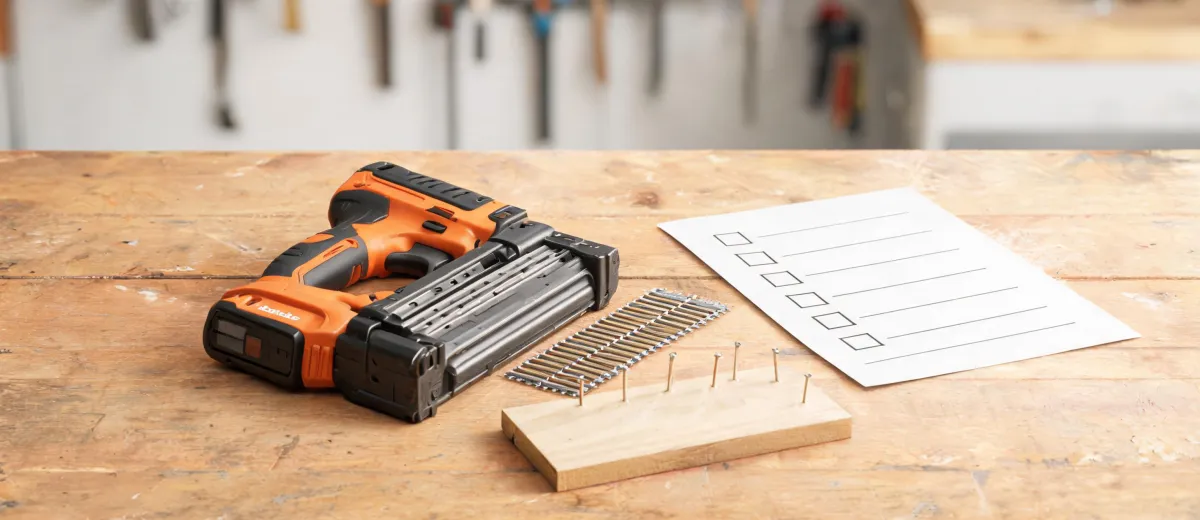
I knew I was in trouble when my lead trim carpenter walked into my office carrying a Paslode nail gun and said, "This one's done." It was the third time that month. We had a $40,000 exterior trim package on the schedule and only one reliable gun left. As the procurement manager for a 14-person millwork company, I've managed our tool budget for over six years — basically every screw, nail, and battery that comes through the shop. I like to think I'm good at cost control. But the next two weeks proved me wrong.
The project that forced the "which nail gun for trim" question
The project was a high-end commercial storefront with heavy architectural trim. The crew needed to run casing, crown molding, door jambs, and a lot of custom details. We already used cordless Paslode tools on other jobs. Honestly, the main reason was convenience: no compressor, no hoses, no lugging an air line around a finished floor. According to Paslode (paslode.com), their cordless nailer system uses a fuel cell and a rechargeable lithium-ion battery. It's basically a little internal-combustion engine in your hand. That works well for trim work where you're moving around scaffolding and ladders.
But we didn't need just any nailer. The question was which nail gun for trim, specifically — and whether we could get away with buying used gear to stay under budget.
The used Paslode nail gun that looked like a smart move
I found a used Paslode nail gun through a local classifieds page. The listing was from someone who'd picked it up at a storage auction. It looked clean: no rust, no bent magazine, light scuffs on the body. The seller was honest about not being able to test it because the fuel cell was missing. Price: $180. A new equivalent was around $425.
I ran the numbers quickly. Best case, I saved $245. Worst case, I was out $180. I told myself the risk was acceptable. Maybe I'd get lucky.
The first afternoon went fine. We put in a fresh fuel cell and a charged battery, and it fired about 50 nails through a piece of poplar. I felt smart. Then the next morning, it jammed. We cleared it. Forty minutes later, it jammed again. Then the driver blade stuck and the trigger wouldn't release. The repair shop said the engine seals were shot and the trigger valve was bad. The estimate to rebuild: $210. So now I was looking at a total of $390 for a used gun that still had a worn-out internal frame. That's when the cost-control part of my brain started screaming.
The hidden costs showed up in other places too
To make things worse, the same week I was dealing with the nailer, I was also trying to track down a 2 inch check valve for the water pump on our service skid. I had ordered a cheap one online because I was trying to nickel-and-dime the shop supplies. It failed within a few days and caused a backup in the pump line. I paid more for the replacement and the plumber's time than I would have spent on the good valve in the first place.
Same story, different shelf. We save a few dollars upfront, then get hit with the cost of the failure later. That's the framing I use now whenever I buy anything for the shop. It's not the purchase price. It's the downtime, repairs, and headaches that decide whether something was really cheaper.
What I did with the broken used Paslode gun
I didn't rebuild it right away. Instead, I let it sit on the shelf for two days while I argued with myself about what to do. Part of me wanted to fix it because I hate wasting money. Another part pointed out that the repair cost was nearly as much as the replacement. I finally sold the broken gun to a guy who rebuilds them for parts, and I put that money toward a new Paslode finish nailer from a local dealer.
The new gun cost $425. That was about $35 more than I had into the used gun plus the repair — but the new gun came with a warranty and a dealer who would fix it fast if something went wrong. I call that $35 the cheapest insurance I ever bought.
What I check now before buying a used Paslode nail gun
I still believe used tools can be great. But if you're tempted by a Paslode nail gun used listing, there are a few things I'd check first:
- Bring a fuel cell and battery to the test. If the seller won't let you fire it, assume it's a parts gun.
- Open the fuel compartment and check the seals for dried-out rubber or debris. On Paslode cordless tools, the fuel cell area takes a beating.
- Look for oil leaks around the cylinder. A clean exterior doesn't mean the engine is clean.
- Run a few fasteners through actual trim material. Not drywall. Not a loose scrap. Use the kind of wood you'll be nailing on the job.
- Factor in the cost of a battery and fuel cell if they aren't included. Those can add $80–$120.
- Ask about the tool's history. It's amazing how often a "light use" tool turns out to be the one that got dropped off a ladder.
That checklist has saved us more than once. By the way, we also picked up a Paslode hammer tacker around the same time. It doesn't drive finish nails, but it's great for quick fastening of weather barrier, felt paper, and house wrap before the trim goes on. It was one of those small purchases that made the crew wonder why we hadn't bought it years ago.
Final take: which nail gun for trim should you choose?
If you're asking which nail gun for trim, I can't speak for every job site. But for what we do, cordless Paslode finish nailers became the go-to. The fuel cell and battery system means there's no hose to drag around, and it drives 16-gauge finish nails into engineered trim and poplar without much effort. Exterior door frames get anchored with exterior lag screws before we ever pull the trigger — the nailer is for casing, crown, and details, not for structural work.
Would I buy another used Paslode nail gun? Maybe. But only if I could fire it first, check the seals, and run the numbers with a realistic repair cost built in. The math changes fast when you add a $200 repair to a $180 "deal."
Five minutes of checking before buying is worth more than five days of fixing after.
That lesson ended up costing me about $35 — or rather, $35 more than I wanted to spend. And I'd do it again every time.

Maren Jorgensen
Maren Jorgensen is an independent hand tool and torque applications analyst covering wrenches, pliers, screwdrivers, hammers, sockets, ratchets, hex keys, and tool sets. She applies ISO 6789-1 torque-tool conformance principles while examining jaw capacity, leverage, fastener engagement, torque range, accuracy, handle geometry, and material hardness. Her practical guides help tradespeople and procurement teams select suitable tools, plan controlled tightening, and compare durability without relying on brand reputation alone.