Paslode Cordless Nailer FAQ: Brad Nailer vs. Impulse Framing Nailer
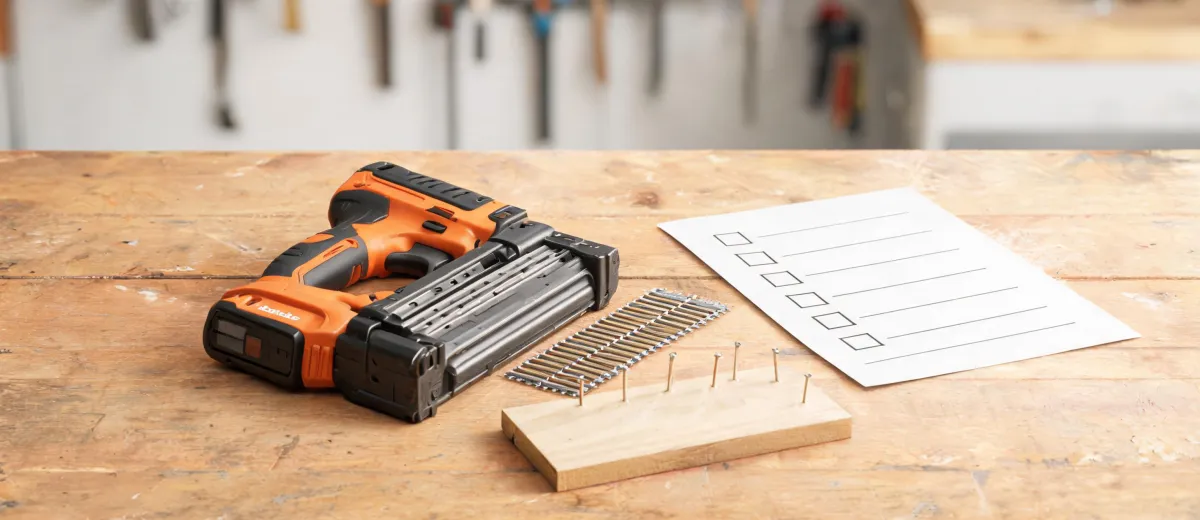
-
What's the difference between the Paslode cordless brad nailer and the Paslode Impulse cordless framing nailer?
-
Does “cordless” mean battery-only? How does Paslode Impulse technology work?
-
How long does a Paslode fuel cell last, and what does it cost per nail?
-
Are Paslode nailers high-maintenance?
-
Is a Paslode cordless nailer worth it if you're not a full-time contractor?
-
How to hang trim without a nail gun
-
What belongs in a custom tool box for a Paslode nailer?
I don't swing a hammer for a living, but I buy the tools that do. I'm the office administrator for a 42-person construction company, and I manage the tool and supply orders that keep our crews moving—roughly $180,000 a year across 20 vendors. When a Paslode nailer stops working on site, I hear about it before the coffee is done.
When I first took over purchasing in 2021, I assumed one nail gun was basically the same as the next. That mistake cost us service time, a few arguments with the crew, and one box of fasteners that still sits in the warehouse. After four years of buying nailers, I've learned that the best tool isn't the one with the biggest discount. It's the one that starts every morning and doesn't quit on a Friday afternoon.
If you're comparing the Paslode cordless brad nailer and the Paslode Impulse cordless framing nailer, you don't need another sales pitch. You need answers. Here are the questions I get asked the most.
What's the difference between the Paslode cordless brad nailer and the Paslode Impulse cordless framing nailer?
They're both cordless, but they do very different jobs.
The Paslode cordless brad nailer is an 18-gauge trim tool. It drives brad nails—small fasteners that leave minimal holes—so we use it for door casing, baseboard, window trim, and cabinet work. It's light enough to handle in corners and easy to carry up a ladder, which is why the trim carpenters call it first.
The Paslode Impulse cordless framing nailer is the bigger tool. It drives the heavy collated nails used for framing walls, sheathing, subfloor work, and structural connections. It has a larger magazine, more weight, and enough power to sink a 3-1/2-inch nail into dense lumber.
In simple terms: the framing nailer builds the bones of the house, and the brad nailer finishes the details. Most of our crews carry both because one doesn't replace the other.
Does “cordless” mean battery-only? How does Paslode Impulse technology work?
No—and this is the thing most first-time buyers get wrong.
A Paslode Impulse nailer is cordless because there's no hose and no power cord. But it doesn't run on a battery alone. It uses a two-part system: a small fuel cell and a rechargeable battery. When the trigger is pulled, the battery powers the ignition and the fuel cell injects a measured burst of fuel into the combustion chamber. The combustion drives a piston, and the piston drives the nail.
Why does this matter to someone like me who mostly sees the numbers? Because it means no air compressor on the job, no hoses running through finished rooms, and no need to be near a power outlet. The tool is self-contained, and that saves time on every single job.
How long does a Paslode fuel cell last, and what does it cost per nail?
This is the first question our accounting team asks.
In our experience, one fuel cell drives roughly 1,000 to 1,200 nails. The exact number depends on nail size, tool condition, and how hard the tool is working. The battery lasts much longer than the fuel cell because it only powers the ignition and electronics—so one battery charge usually outlasts several fuel cells.
When I ordered Paslode fuel cells in January 2025, we paid about $50 for a two-pack through our regular supply house. Do the math and the power source costs about two cents per nail. That's tiny compared with the cost of an hour of labor lost to a tool that won't fire.
Here's something a lot of buyers don't think about: fuel cells have date codes for a reason. Old cells and cheap counterfeits leave the combustion chamber dirty and cause misfires. Buy from a reputable dealer and check the date on the package. Prices as of January 2025—verify current pricing with your supplier.
Are Paslode nailers high-maintenance?
Less than you'd expect, but I'd never call them zero-maintenance. Any tool that does this kind of work needs care.
Regular maintenance is simple: keep the nose clean, add a drop of tool oil in the recommended spot, and charge the battery at the end of the day. We do a deeper cleaning of the combustion chamber every few weeks and before putting tools into storage.
Most of our service calls don't come from regular use. They come from neglect and cheap consumables—a fuel cell left in a hot truck, a battery that sits dead for two months, or fasteners that weren't designed for the tool.
I learned that the hard way in 2023 when I ordered budget nails to save a few dollars a box. They jammed often enough that the crew lost a morning on a punch list, and the supervisor made sure I heard about it. Now we buy fasteners that match the tool's specifications and don't look back.
Is a Paslode cordless nailer worth it if you're not a full-time contractor?
Sometimes yes, sometimes no. If you're asking me honestly, I'll give you the same answer I gave our finance manager.
A Paslode cordless nailer is a production tool. Comparing it to the garden hand tools in the back of a homeowner's shed isn't a fair test. One is built for weekend projects; the other is meant to earn its keep every day on a job site. If you have one weekend of trim work, buying a new nailer probably isn't the smartest move.
Take a rough example. If a cordless nailer saves 30 minutes a day over a two-week project, that's about five hours of labor—$200 or more, depending on the local rate. Run that calculation against the price of the tool and the decision gets easier.
But if you're doing a whole-house remodel, managing rental properties, or running a crew, the math changes even faster. And in my experience, a reliable tool that costs more upfront is cheaper in the long run than a bargain tool that costs you billable hours.
How to hang trim without a nail gun
It's a legitimate question, and the short answer is yes. Hand-nailing trim was standard practice before nail guns became common. So the real question isn't whether it can be done—it's how long it will take and how clean the result will be.
The classic hand-nailing method works like this:
- Cut and dry-fit each piece of trim.
- Drill small pilot holes where the wood is likely to split.
- Drive finish nails with a hammer, then set the heads with a nail set.
- Fill the nail holes and touch up the finish.
That method works fine for one door casing or a small repair. It's slower, and there's a higher risk of denting the wood or splitting thin molding. For a single weekend project, I'd use this approach before buying a nailer.
For a larger job, the labor savings usually justify a nailer rental—or a Paslode cordless brad nailer if you do trim work regularly. Hand-nailing an entire house can take days. A cordless brad nailer can finish the same work in a fraction of the time.
What belongs in a custom tool box for a Paslode nailer?
Plan the storage before you buy the tool. That's advice I wish someone had given me when I started ordering tools.
A good custom tool box is cheap insurance for a nailer that costs several hundred dollars. We use foam inserts cut to the shape of each tool, so the nailer doesn't slide around and the fuel cell housing doesn't take a beating. It also tells the crew exactly where the tool goes at the end of the day.
Here's what we keep in each custom tool box:
- The nailer in a foam cutout.
- One spare fuel cell in a sealed bag.
- A charged battery.
- A small bottle of recommended tool oil.
- A box of the correct fasteners for that tool.
One warning: don't pack the foam so tight that it holds moisture. A damp insert can cause more rust than a dusty job box. Ventilation matters as much as protection. If you're setting up a box for the first time, buy one size larger than you think you need—batteries, chargers, and spare cells take up more room than people expect.

Maren Jorgensen
Maren Jorgensen is an independent hand tool and torque applications analyst covering wrenches, pliers, screwdrivers, hammers, sockets, ratchets, hex keys, and tool sets. She applies ISO 6789-1 torque-tool conformance principles while examining jaw capacity, leverage, fastener engagement, torque range, accuracy, handle geometry, and material hardness. Her practical guides help tradespeople and procurement teams select suitable tools, plan controlled tightening, and compare durability without relying on brand reputation alone.