Paslode Cordless Framing Nailer Parts, Batteries, and the Tools You Shouldn't Buy From a Nail Gun Dealer
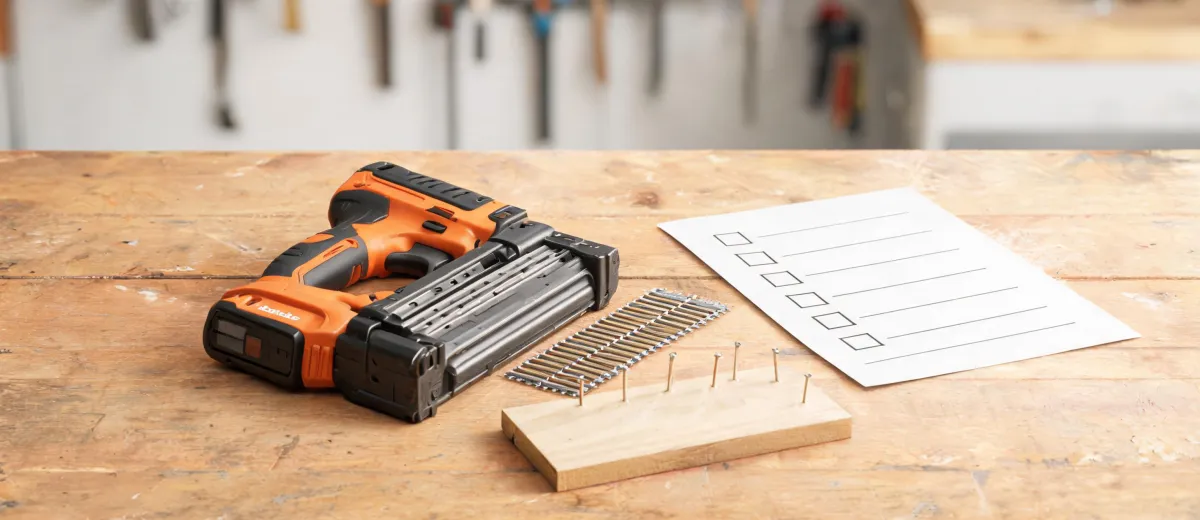
There's no one-size-fits-all tool order
If you ask me whether every tool order should start with Paslode, the honest answer is no. It depends on what you're actually doing. That's not the fun answer, but it's the one that saves you money. I've spent the last 8 years ordering tools and replacement parts for a framing crew. I've personally made and documented 31 significant ordering mistakes, totaling roughly $7,400 in wasted budget. Now I keep a checklist and train our crew with it.
The trick is knowing what kind of problem you're solving. A fastening tool on a deadline demands brand accuracy. A general shop kit is a commodity. A mystery fastener is an education problem before it's a purchasing problem. I've made every one of these mistakes, and I've got the receipts to prove it.
The reason I write this down is simple: too many buyers swing between two extremes. Either they insist on brand-specific everything, or they buy the cheapest generic version of whatever shows up first. Both paths hurt. Let me give you three scenarios and what I would do in each one.
Scenario 1: When genuine Paslode cordless framing nailer parts are worth it
If the tool is a Paslode cordless framing nailer that's on a job site five days a week, the parts list matters. I learned this in 2018 on a $3,200 order where I ordered four replacement kits without checking the tool model. The kit looked right in the photo. It wasn't. $680 down the drain and a 1-week delay.
Paslode's cordless framing nailer runs on a fuel cell and a rechargeable battery, not on an air compressor. That makes it easier to carry around, but it also means there's no universal parts bin. The fuel cell, the battery, the charger, and the tool itself all have to work together. Search for paslode cordless framing nailer parts and you'll see a long list of model-specific components. The same nailer family uses different bumpers, drive blades, nose assemblies, and o-rings.
As of March 2025, the parts lookup on Paslode's website (paslode.com) is still the fastest way to confirm which part is actually on your tool. If the diagram doesn't match your model, don't order. What I mean by that is the cheapest option isn't just about the sticker price. It's about the total cost including your time spent managing returns, the risk of a job site delay, and the possibility that a part fails in the middle of a deck. I've paid that cost more than once.
Same goes for power. When I look for batteries for paslode nail guns, I check three things: the battery model, the charger compatibility, and the tool model stamped on the door. I don't assume the newest battery is backward-compatible. In 2021 I ordered two upgraded batteries that fit nothing we owned. They sat in a drawer for months before I sold them at a loss. There's nothing satisfying about that.
Had 2 hours to place an order before the supplier's cutoff one Friday. Normally I'd verify every part against the diagram, but there was no time. I went with part numbers from our last order and didn't look back. One number had been superseded. $290 wasted, and I'm the one who always says to check the diagram. Embarrassing.
My current policy: If a job depends on it, order genuine replacement parts. The markup is annoying, but the time-loss of a misaligned aftermarket part is worse. There are a few exceptions, but I treat those as exceptions, not the rule.
Scenario 2: When the order should go to a different specialist
Here's where I've made the other kind of mistake. Paslode is a specialist in gas fuel cell-powered fastening tools and fasteners. It is not a general hardware distributor. I have mixed feelings about one-stop shops. On one hand, fewer vendors means easier invoices. On the other hand, ordering a plumbing valve from a nail gun dealer is how you end up with a valve that looked right in the thumbnail but had the wrong connection type.
Why do I bring up a mechanics tool set and a ball valve in an article about Paslode? Because it's easy to fall into the trap of buying everything from one place. I've done it too. A project manager once told me to order whatever was easiest. That's how I paid $120 for a small plumbing part from a fastening supplier. The part worked, but the markup was painful. The specialist down the street had the same thing for less.
Two examples from our shop:
- A 243-pc mechanics tool set. This is a general-purpose toolkit item. There is no reason to tie it to a Paslode purchase unless your supplier happens to offer a package price. The value is in the sockets and drive sizes, not the brand on the case. If the set has the sizes you need and decent chrome, it's fine. I don't need a nailer brand to endorse a socket.
- A sweat isolator full port ball valve 51404w. That part number has nothing to do with framing. It's a plumbing specialty. The right person to ask about it is a plumbing supplier or the valve manufacturer. I do not care how durable a nail gun is; it does not make a company an expert on full port ball valves. The vendor who says that's not our strength, and then points to who does it better, earns my trust for everything else.
That last point is important. In Q3 2024, I called our regular supplier about a sweat isolator full port ball valve 51404w. Instead of guessing, the guy said that's not us and pointed me to a plumbing supply house. He lost a small order but kept the rest of our business. That's the kind of honesty I now build my vendor list around.
Scenario 3: When the problem is identification, not brand
Sometimes the issue isn't which brand to buy. It's knowing what the thing is. The search query what does a self drilling screw look like sounds basic, but it's easy to get wrong. In 2022 I ordered 3,000 self-drilling screws. They arrived and looked like normal screws with a sharp point. The job was metal-to-metal. The screws wouldn't drill. That was a $450 mistake plus a 2-day rental extension on a lift we didn't need.
A self-drilling screw is designed to drill and tap in one step. It only works if the point is actually ground like a drill bit. A regular sheet metal screw may have a sharp point, but it's not designed to cut a hole through thicker steel. The easiest way to tell: a self-drilling screw has a drill-bit-shaped tip, usually with a small flute or notch at the point. It cuts its own hole as it goes in. A self-tapping screw has a sharp point but usually doesn't have that drill tip and may need a pilot hole in thicker metal.
Next time you search what does a self drilling screw look like, skip the head styles and zoom in on the point. Phillips versus Torx doesn't tell you whether it drills. If I can't confidently identify a fastener, I now buy a small pack first. Not ideal, but a $10 sample pack is cheaper than 3,000 useless screws.
How to tell which scenario you're in
I don't want to end with it depends and leave you hanging. Here's the decision guide that's on our office whiteboard.
- Is it a high-use Paslode tool or part of one? If yes, research the exact model, check the diagram, and buy genuine.
- Is it a general hand tool, plumbing item, or something outside fastening? Buy from the specialist in that category. Let a plumbing supplier quote the valve; let a tool distributor quote the mechanics set.
- Are you unsure what the item is? Stop. Take a photo, compare the tip or connection type, and buy a sample before bulk ordering.
If you still can't tell, call the supplier and ask for a photo of the actual product. If they don't know what you're asking for, that tells you something. In Q3 2024, we had a vendor send us a picture of a self-tapping screw when we asked for a self-drilling screw. We caught it before ordering. That photo test is now part of our checklist.
There's something satisfying about finally having this process. After 31 mistakes, we've caught 13 potential wrong-part orders in the past five months using the checklist. That doesn't sound dramatic, but every one of those was a job-site delay I didn't have to explain to a project manager.
Buying tools and parts for a crew isn't about proving loyalty to one brand. It's about matching the right specialist to the right problem. Paslode makes a great cordless framing nailer, and I use those parts every week. But if you need a 243-pc mechanics tool set or a sweat isolator full port ball valve 51404w, you should call someone who specializes in that. The most professional thing anyone can say is: That's not our area, here's who should handle it.

Maren Jorgensen
Maren Jorgensen is an independent hand tool and torque applications analyst covering wrenches, pliers, screwdrivers, hammers, sockets, ratchets, hex keys, and tool sets. She applies ISO 6789-1 torque-tool conformance principles while examining jaw capacity, leverage, fastener engagement, torque range, accuracy, handle geometry, and material hardness. Her practical guides help tradespeople and procurement teams select suitable tools, plan controlled tightening, and compare durability without relying on brand reputation alone.