Paslode CFN325XP vs Pneumatic Framing Nailer: A Buyer's Side-by-Side
Before the Comparison: What Does a Nail Gun Look Like?
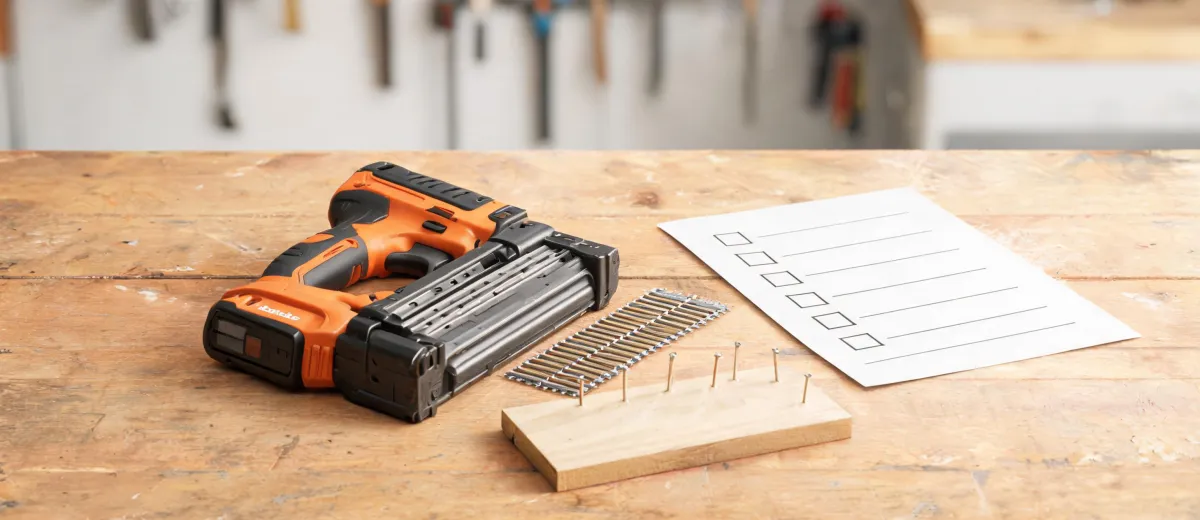
I manage purchasing for a 40-person general contracting company. I order tools, fasteners, and fastening supplies, and I report to both operations and finance. One question I get from newer office staff and even some homeowners is what does a nail gun look like? The answer is easier than you'd think.
A nail gun looks like a caulk gun with a trigger and a magazine underneath the barrel. You press the nose against the wood, pull the trigger, and a piston drives the nail in. A framing nailer is the larger version. It uses a bigger framing nail, and it hits with enough force to hold wall assemblies together. If you're trying to pick between a cordless framing nailer and a pneumatic one, the look is only the start. The real difference is what's behind the gun.
Why I Set Up a Side-by-Side
Our company does residential framing, light commercial work, and deck tear-offs. The question came up when an air compressor started failing in late 2024. I had two options: fix the compressor or try a Paslode CFN325XP cordless framing nailer and see if we could live without it.
I asked our framing leads to run the Paslode against the old pneumatic setup for two weeks. I wanted to compare three things:
- Portability and setup time
- Power and driving consistency
- Total cost after one season
I also asked them to keep an eye on fasteners. We do a lot of deck work, and I always keep 10 x 3-in wood to wood deck screws in stock for the places where screws are the right choice. But framing is a different task.
Dimension 1: Portability and Setup
The pneumatic rig required a compressor, a hundred feet of hose, a generator or an outlet, and a second trip to the truck if the crew forgot a fitting. Setup took ten minutes on a good morning. If it was cold and the compressor wouldn't start, setup took longer.
The Paslode CFN325XP cordless framing nailer is self-contained. A fuel cell and a battery snap into the handle area. A box of nails goes in the magazine. That's it. One person can carry the tool, fuel cells, and a box of nails in a single load.
When I compared our old setup to the cordless one side by side, I finally understood why portability matters more than the power number on a spec sheet. The crew wasn't waiting on the compressor. The tool was already loaded when the pneumatic setup was still being unloaded.
Dimension 2: Power and Consistency
Here's the thing: I expected the pneumatic to win this one on raw force. It didn't, at least not in a way that changed the job. That does not mean the Paslode doesn't have power; it has enough for the framing we do.
The pneumatic nailer had a harder kick and a louder crack. The Paslode is quieter, with a distinct gas-assisted pop. But the nails went in straight and flush on everything from spruce studs to engineered rim board. We used 3-1/4 in nails for most of the test, and the tool drove them without sinking below the surface.
The one surprise was consistency. A compressor cycles on and off, and the air pressure at the gun changes as the tank refills. The Paslode CFN325XP fires the same from the first nail to the last. That consistency matters when you're nailing off a wall and don't want to stop to check for proud nails.
The tool and fastener combination should also match the manufacturer's rated angle and collation. That's not a preference; it's how the tool is designed. And before clearing a jam on any pneumatic tool, disconnect it from the air supply. That's standard safety practice.
Dimension 3: Total Cost and the Compressor Problem
Cost comparisons usually focus on the tool price. If you already own a compressor, a pneumatic nailer looks cheaper. The Paslode has an ongoing cost for fuel cells and batteries, and I won't pretend that's nothing.
But there's the second side of the equation.
Our old compressor had a check valve problem. Then it wouldn't build pressure. I typed air compressor not building pressure into search almost as often as I called the repair shop. Between the first repair visit, the second one, new hoses, and the fuel to run the compressor, the 'cheaper' pneumatic system cost us more that quarter than the Paslode did.
Look, I only believed the 'fuel cell cost is not the real expense' argument after ignoring it and paying an $800 repair bill. Not my smartest lesson, but I learned it.
If you're shopping a framing nail gun Paslode sale, don't compare only the gun price. Look at what's in the bundle. A kit with fuel cells, a battery, and a charger is usually the better buy because you'll need those items anyway.
Dimension 4: Nails vs. Wood-to-Wood Deck Screws
One keyword that shows up in my searches is 10 x 3-in wood to wood deck screws. It's a specific size I order for decks, and it's worth talking about because it points to a different question: when do you screw instead of nail?
For deck framing, there are areas where a 10 x 3-in wood to wood deck screw is the right call. Screws hold a ledger board securely and are less likely to back out under dry-wet cycling. Collated nails work differently in shear and bearing, but for many wood-to-wood connections, a screw is a stronger choice in pull-out.
That does not make a nail gun useless. For wall framing, roof framing, and most structural connections, a collated framing nail is faster and structurally appropriate. We keep a box of 10 x 3-in wood to wood deck screws in the warehouse, and we still order Paslode nails for the crews. Different fasteners for different jobs.
What I Finally Recommend
If you're a solo carpenter or a small crew doing remodels, additions, and decks, I'd start with the Paslode CFN325XP. It eliminates the compressor and makes you more flexible. If you're a large commercial framer who already has a well-maintained compressor and you frame all day, pneumatic is still a legitimate choice. I'm not going to tell you to throw away an air nailer that works.
Risk weighing was the hardest part for me. The upside of the cordless was a simpler jobsite. The risk was running out of fuel cells or a dead battery in the middle of a critical wall. I kept asking myself if the convenience was worth it. After two weeks of side-by-side use, I had my answer. The crew stopped reaching for the compressor hose.
Even after I placed the order, I kept second-guessing. What if we run out of fuel cells on a Monday? I didn't relax until the first full week ended without a single complaint.
What was best practice in 2020 may not be the best practice in 2025. The fundamentals—matching the fastener to the task and checking your gear before you leave the yard—haven't changed.
If you're reading this because you want to know what does a nail gun look like, or because your compressor stopped building pressure, or because you're trying to decide between nails and screws for a deck, the honest answer is: start with the job, not the tool. That's what buying for a crew has taught me.

Maren Jorgensen
Maren Jorgensen is an independent hand tool and torque applications analyst covering wrenches, pliers, screwdrivers, hammers, sockets, ratchets, hex keys, and tool sets. She applies ISO 6789-1 torque-tool conformance principles while examining jaw capacity, leverage, fastener engagement, torque range, accuracy, handle geometry, and material hardness. Her practical guides help tradespeople and procurement teams select suitable tools, plan controlled tightening, and compare durability without relying on brand reputation alone.