Cordless Gas vs Pneumatic Framing Nailers: A Deadline-Driven Comparison for Pro Crews
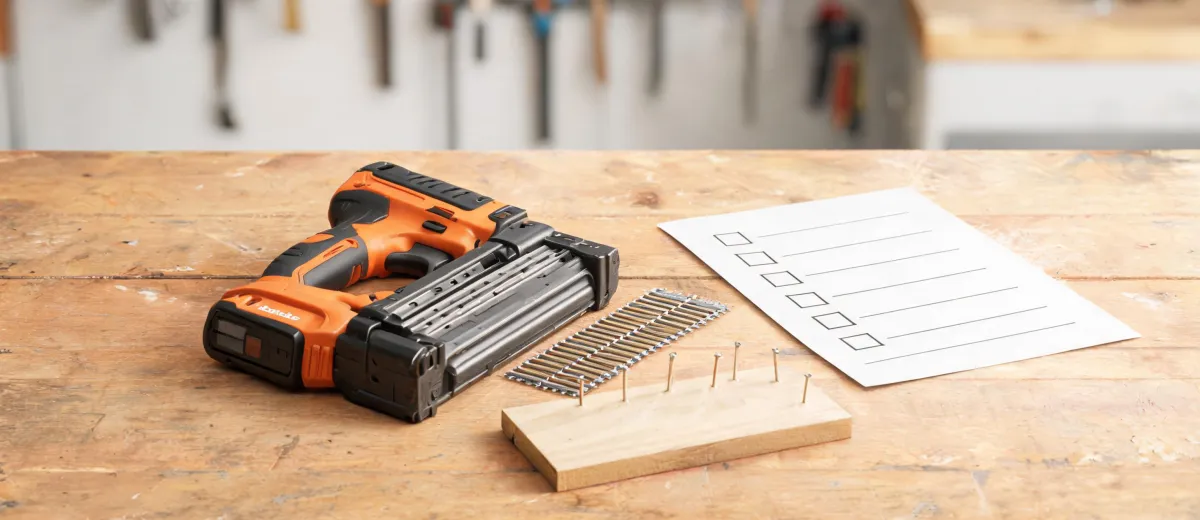
If you are outfitting a framing crew, the choice usually comes down to two setups: cordless gas nailers—like the paslode framing nail gun—or pneumatic nailers fed by a compressor and hose. I review tool and accessory specs for a construction supply distributor. About 200 SKUs a year pass my bench. In 2024, we rejected roughly 12% of first deliveries because of spec drift: wrong hose fittings, damaged cases, missing fuel cells. So I look at this less as a brand fan and more as a quality gate.
I am comparing them across five dimensions: setup and mobility, air supply and hose size, runtime and consistency, storage and transport—including the paslode nail gun case—and the supporting kit, meaning your hammer set and cordless drill. I am not a pneumatic systems engineer, so I cannot give you exact CFM calculations for high-altitude jobs. What I can tell you is what holds up under deadline pressure.
Dimension 1: Setup and Mobility
Pneumatic setup means compressor, hose, fittings, and a place to park all of it. Cordless gas setup means battery, fuel cell, and the nailer itself. That difference matters most when the crew is not working in one spot. Hose drag slows you down. Compressor placement becomes a negotiation. On a remodel or a scattered addition, cordless gas usually wins because one person can grab the tool and go.
Pneumatic still wins in one clear case: a fixed production area where air is already piped and the crew is not moving far. There, the hose is not a burden. It is infrastructure.
My take: mobility goes to cordless gas. Stationary volume goes to pneumatic. Not because one technology is better, but because the jobsite layout decides.
Dimension 2: Air Compressor Hose Size vs Fuel Cell and Battery Discipline
For pneumatic framing nailers, air compressor hose size is not a detail. It is the difference between a tool that hits full depth and one that sounds weak all day. Framing nailers commonly call for a 3/8-inch ID hose (inner diameter, not outer). Finish nailers often use 1/4-inch. If you put a 1/4-inch hose on a framing nailer, you may starve the tool.
I still kick myself for not standardizing hose size across our rental fleet. We had 1/4-inch hoses on framing nailers, and crews kept blaming the tools for lack of power. It was the hose. Simple as that. After we switched to 3/8-inch ID on the framing racks, the complaints dropped. That experience taught me to check the manual before I blame the nailer.
Cordless gas has its own discipline: fuel cells and batteries. A paslode framing nail gun depends on a clean fuel cell and a healthy battery. Store them correctly. The paslode nail gun case is not just a bag. What most people don't realize is that a cracked case often means a bent fuel cell valve or a damaged battery terminal. You may not see it until the tool misfires on site.
My take: pneumatic demands correct air compressor hose size. Cordless gas demands correct storage and fuel management. Both fail when the supporting details are ignored.
Dimension 3: Runtime, Consistency, and Deadline Certainty
Pneumatic nailers deliver consistent power as long as the compressor keeps up and the hose is sized right. Cordless gas nailers deliver independence from air. For deadline work, independence has a value that is hard to put on a spec sheet.
In March 2024, we paid $300 extra to overnight a replacement battery and fuel cell to a crew facing an inspection deadline. The alternative was missing a $15,000 window. The premium bought certainty, not just speed. That is the same logic I use when I evaluate any tool setup: an uncertain cheap option is more expensive than a known reliable one when the deadline is fixed.
The value of guaranteed tool readiness is not the speed. It is the certainty that the crew will not stop.
Pneumatic is often the better choice for high-volume, fixed-location work. Cordless gas is often better when the crew moves and the schedule is tight. Neither is a universal answer.
Dimension 4: Storage and Transport
Storage is where quality issues hide. A paslode nail gun case protects the tool, battery, and fuel cell from vibration, dust, and impact. We have seen case latches fail after months of truck-bed abuse. When that happens, the tool starts arriving with bent rails or dirty contacts. It is a slow failure, not a dramatic one.
Pneumatic kits need equal attention: hose reels, fittings, and couplers. A cheap coupler that leaks will cost more in compressor cycles and downtime than it saves at purchase. The hose itself should be inspected for cuts and kinks. If you are comparing kits, do not compare only the nailer. Compare the storage and transport system around it.
My take: the case is part of the tool's reliability. If the case is an afterthought, the tool will become one too.
Dimension 5: The Supporting Kit—Hammer Set and Cordless Drill
Whichever nailer you choose, the crew still needs a hammer set and a cordless drill. These are not side notes. They are the tools that keep the nailer working.
For a hammer set, look for forged steel, a balanced weight, and grips that reduce vibration. A cheap hammer set can mar surfaces and wear out wrists. In a framing crew, it gets used for adjustments, tapping, and persuasion. Buy one that can take a hit.
For a cordless drill, the what to look for cordless drill buying guide is shorter than most people make it. Brushless motor. 1/2-inch chuck. Two-speed gearbox. A clutch that does not slip on driver bits. And a battery platform you already own. If you are already invested in a platform, stay there unless the drill is clearly better. The nailer battery does not have to match your drill, but every extra charger adds clutter and failure points.
My take: do not let the nailer decision force a bad drill or hammer set decision. The supporting kit is where crews lose time when it fails.
Selection Guide: When to Choose Which
Choose a cordless gas setup, like a paslode framing nail gun, when the crew moves between sites, when compressor setup is a bottleneck, or when deadline certainty matters more than the lowest upfront price. Keep the paslode nail gun case in good shape. Track fuel cells and batteries like you track fasteners.
Choose pneumatic when you have fixed air, high-volume production, and the discipline to use the right air compressor hose size. Use 3/8-inch ID for framing nailers unless the manual says otherwise. Maintain couplers and hoses. It can be a very efficient system.
My experience is based on about 200 tool and accessory SKUs we stock and inspect annually. If you are running a 20-crew commercial framing operation, your experience might differ. But the quality principles hold: check the spec, verify the support system, and pay for certainty when the deadline is real.
Speed, consistency, independence. Pick your priority. Then build the kit around it—not around the lowest line item.

Amara Nwosu
Amara Nwosu is an independent hydraulic tool and pump systems analyst covering jacks, cylinders, pullers, torque wrenches, hand pumps, power pumps, and porta-power equipment. She applies ISO 4413 safety principles while examining rated pressure, cylinder force, stroke, oil volume, flow, return type, hose condition, load holding, pressure loss, and relief protection. Her technical guides help maintenance and construction teams configure compatible systems, verify safe capacity, and diagnose slow or unstable operation.