After a Dead Compressor, We Switched from Paslode Pneumatic Framing Nailer to Cordless
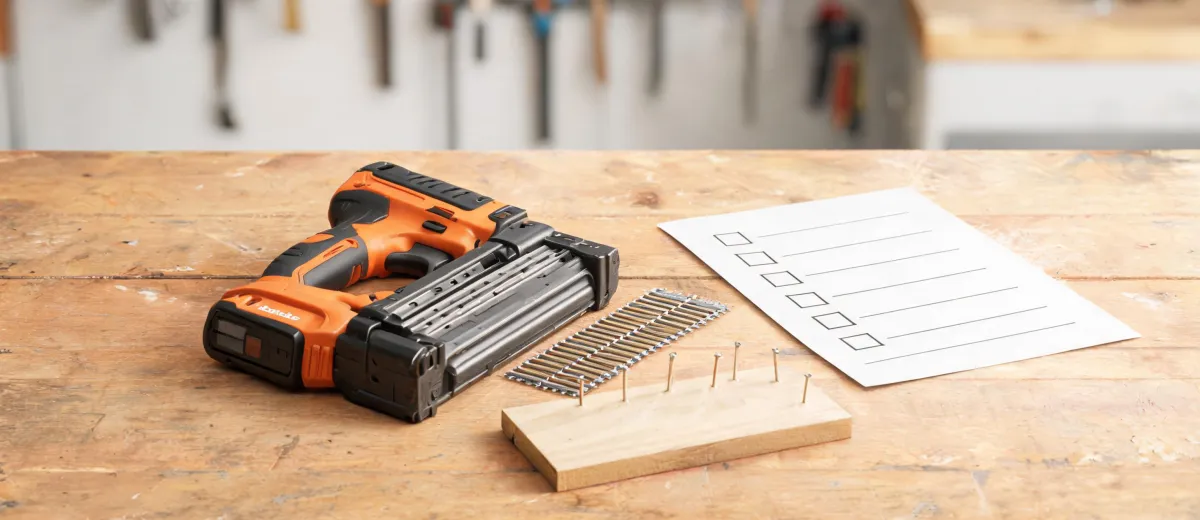
I'll admit something up front: I don't frame walls. I buy what frames them and make sure it shows up before somebody asks why it didn't. I'm the office administrator for a 40-person construction and renovation company in the Midwest. Since 2020, I've managed roughly $600,000 in purchases a year across 8 vendors. That works out to 60–80 orders, depending on the season.
People assume purchasing is an office job. What they don't see is that almost every real decision starts with a call from a jobsite. The call that changed how I buy tools came on October 17, 2024.
The morning a compressor stopped being “just a compressor”
We were converting an old dairy barn into a workshop. The power company hadn't tied in the new service yet, so the crew was running on a portable generator and a compressor borrowed from another site. From the outside, that sounds workable. On site, it was tight. The compressor was too small to keep up with a framing nailer running steadily, and whenever someone added a work light, the breaker tripped.
Honestly, the crew dealt with it. Nail a few studs, wait for air to build up, nail a few more. Not ideal, but workable. We had used the Paslode pneumatic framing nailer for years, and it was never the source of the complaint. The complaint was everything around it: hoses, the compressor, the power supply, the repair tech we couldn't find on a Thursday morning.
Then around 10:30, the compressor quit. No bang, no warning—just wouldn't restart. The crew stood in the doorway for an hour while we tracked down a repair tech who couldn't come until the next day. If you've ever watched a crew stand around because of a support tool, you know the feeling. The job doesn't get cheaper while people wait.
Then a foreman asked about “the cordless one”
“Why are we still dragging air compressors?” the foreman said. “We should have the Paslode cordless framing nailer on this.” I didn't know what he was talking about. A cordless framing nailer requires a massive battery. I couldn't picture it.
He explained: the Paslode cordless system isn't battery-only. It uses a fuel cell plus a rechargeable battery. The gas ignites to drive the piston; the battery handles ignition and the motor. No hose. No compressor. No air dryer.
Look, I'm not an engineer. I just approve purchase orders. But the numbers were clear: one idle crew day on that barn cost more than the tool. So we called the nearest dealer, got one in stock, and I added an extra Paslode cordless framing nailer battery to the order because a nailer without a charged battery is just an expensive paperweight. Or a hammer.
Now, I don't buy tools on marketing claims. Per FTC guidelines, product claims are supposed to be truthful and backed up with evidence (ftc.gov), but I still prefer a spec sheet to an ad. The spec sheet said the tool would handle the 2¾-inch nails we were driving in that barn wall. Watching the crew sink them without an air hose was better proof.
Our 19°F lesson
For the next two weeks, the cordless nailer was the hero of the project. Then November happened, and I almost replaced a perfectly good tool because I didn't respect the cold.
One morning the temperature sat at 19°F. The nailer would fire one or two weak nails, then stop. The crew sent it back to the shop sure it was defective. I started looking up replacement costs before I remembered: the manual says fuel cells and lithium-ion batteries don't like extreme cold. The nailer had spent the night in an unheated equipment trailer.
I knew better. I had read that section. But I thought, “It's a trailer, how cold can it really get?” The odds caught up with me.
We brought the battery and fuel cells inside, gave them about 45 minutes near a heater, and drove back. The nailer worked perfectly. Not defective. Cold.
Lesson learned the hard way: cordless doesn't mean maintenance-free. It just has different maintenance. The fuel cell is temperature-sensitive; the battery wears out; the charger needs to be in a dry place. Since then, the cold-weather storage rule is on our checklist, not in a PDF nobody opens.
Anchors: the part of the job I didn't expect to care about
The barn job also taught me that anchors are not all the same thing. One afternoon, the crew lead asked me to order an HCA coil anchor. I made him spell it. It sounded like a building product—not a fastener. But it's a hardened steel coil anchor for fastening wood to concrete or masonry, and it comes in a coil, so the nailer can feed it automatically. That coil is exactly what you need when a treated sill plate has to sit tight against a concrete foundation.
From the outside, it's another box on the truck. The reality: using the wrong anchor means the whole connection is suspect. If a project is spec'd for an HCA coil anchor, you don't substitute a smooth shank nail and hope it holds.
A few weeks later, the office side of our company needed the opposite lesson. We had built a small training room with fresh drywall, and I needed to hang a whiteboard. The whiteboard kit came with plastic anchors, but I had no idea whether they were right for the wall. So I typed how to screw anchors into drywall into my search bar at 4:50 p.m., which is not a question I expected to ask as a grown adult.
The answer, basically, is: drywall anchors are designed for hollow walls. They expand behind the drywall or bite into it. You don't use a concrete anchor like an HCA coil anchor in drywall—drywall isn't solid enough for that kind of grip. Match the anchor to the material, not just to the weight of whatever you're hanging. Simple once you know.
Slightly embarrassed? Yes. But it also made me realize how much of this trade is fasteners and knowing which one goes where.
The 135-piece purchase that saved the office
While I was still researching anchors, our maintenance guy asked if he could order a 135 piece tool set. Our shop had upgraded almost everything else in the company, but the office toolbox was still a drawer of mismatched screwdrivers and one rusty adjustable wrench.
I said yes. The 135 piece tool set turned out to be genuinely useful—not because we needed all 135 pieces, but because it had the right screwdriver bits, sockets, and basic tools when we mounted the whiteboard. I used it to drive those drywall anchors, and the job took ten minutes.
A specialized cordless framing setup solved the framing problem. A reasonably priced 135 piece tool set solved the office problem. Both matter; neither is “just a tool.”
What I'd tell another person who buys tools
Here's the thing: the industry changed while I wasn't looking. In 2020, best practice for a framing crew meant owning a reliable air compressor and knowing how to maintain it. By 2025, the better answer on a jobsite without power might be a Paslode cordless framing nailer and a small shelf of fuel cells and spare batteries.
The fundamentals haven't changed—you still need a nail driven flush, and you still need an anchor that grips the material underneath. But the execution has transformed. That's not a knock on pneumatic tools. We still own them, and they're still the right call when a compressor is already on site. The lesson is not “cordless always.” It's that “always” has a short shelf life.
Three things, in case it helps:
- The most expensive tool is the one you can't use when the crew is waiting.
- Cordless doesn't mean zero maintenance. It means a different list: batteries charged, fuel cells stored at room temp, spares on hand.
- Anchors are not interchangeable. Concrete calls for an HCA coil anchor with the right tool; drywall calls for an anchor that expands in the void. Knowing how to screw anchors into drywall matters as much as choosing the right nailer.
I still wouldn't call myself a tool expert. I'm the person who signs the purchase orders and answers the 4:50 p.m. search questions. But when I look at a jobsite now, I see the whole chain: battery, fuel cell, coil, anchor, and the person who knows which one goes where.
That person isn't me. But I know who to call—and now I know what to buy.

Maren Jorgensen
Maren Jorgensen is an independent hand tool and torque applications analyst covering wrenches, pliers, screwdrivers, hammers, sockets, ratchets, hex keys, and tool sets. She applies ISO 6789-1 torque-tool conformance principles while examining jaw capacity, leverage, fastener engagement, torque range, accuracy, handle geometry, and material hardness. Her practical guides help tradespeople and procurement teams select suitable tools, plan controlled tightening, and compare durability without relying on brand reputation alone.